Week 3,4 – Anna

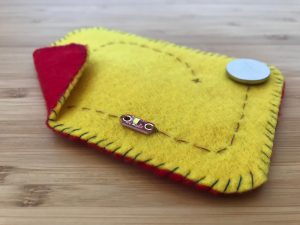
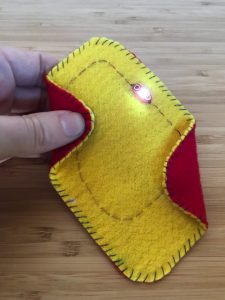
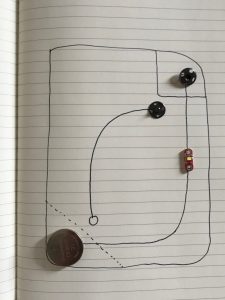
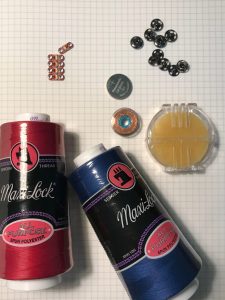
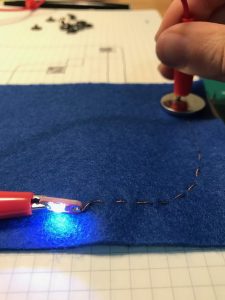
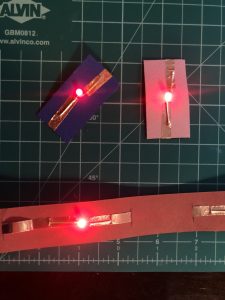
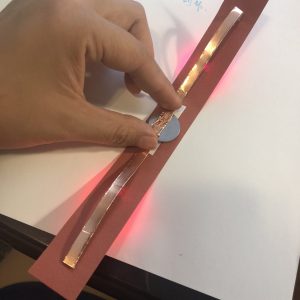
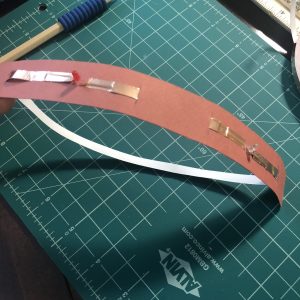
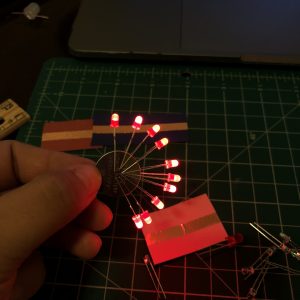
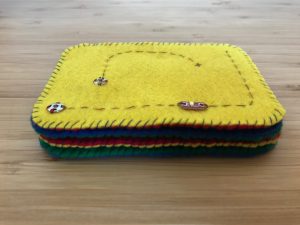
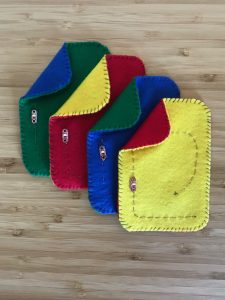
Oh snap! These four swatches use copper thread with a snap switch. When the circuit is closed, the mini LED shines.

** Swatches **

** Swatch materials and process **

** Learn a new craft **

Last week, I did hand sewing for the first time through my swatch-making. I also took a silkscreen printmaking class, and am looking forward to playing with printmaking and conductive ink in a future project this semester.

Week 3 HW – Zhenyuan(Christina) Shi

For this week’s homework, I created a selection switch which allows the user to choose which light to be turned on. I used conductive thread and sewable LEDs.

And I then I made three identical ones, in which I used different materials to achieve the same effect.

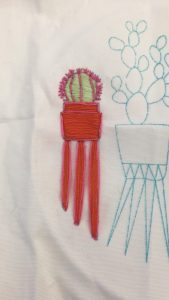
For learning a new craft, I learned embroidery.

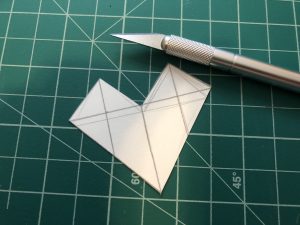
My favorite tool is X-ecto knife, because I really like working with paper and the knife makes it very fast and precise it could cut paper.

I think I would identify my practice as storyteller, maker, designer, and craftsperson. Since I came from a film background, it is quite important for me that my piece of work carries a story or some kind of narrative. I consider myself as also a maker&craftsperson because I am really into DIY culture and I’m passionate about figuring out how things work and constructing them.

Daisy bud – Week 3 & 4 – Carla

PART 1: Daisy Bud


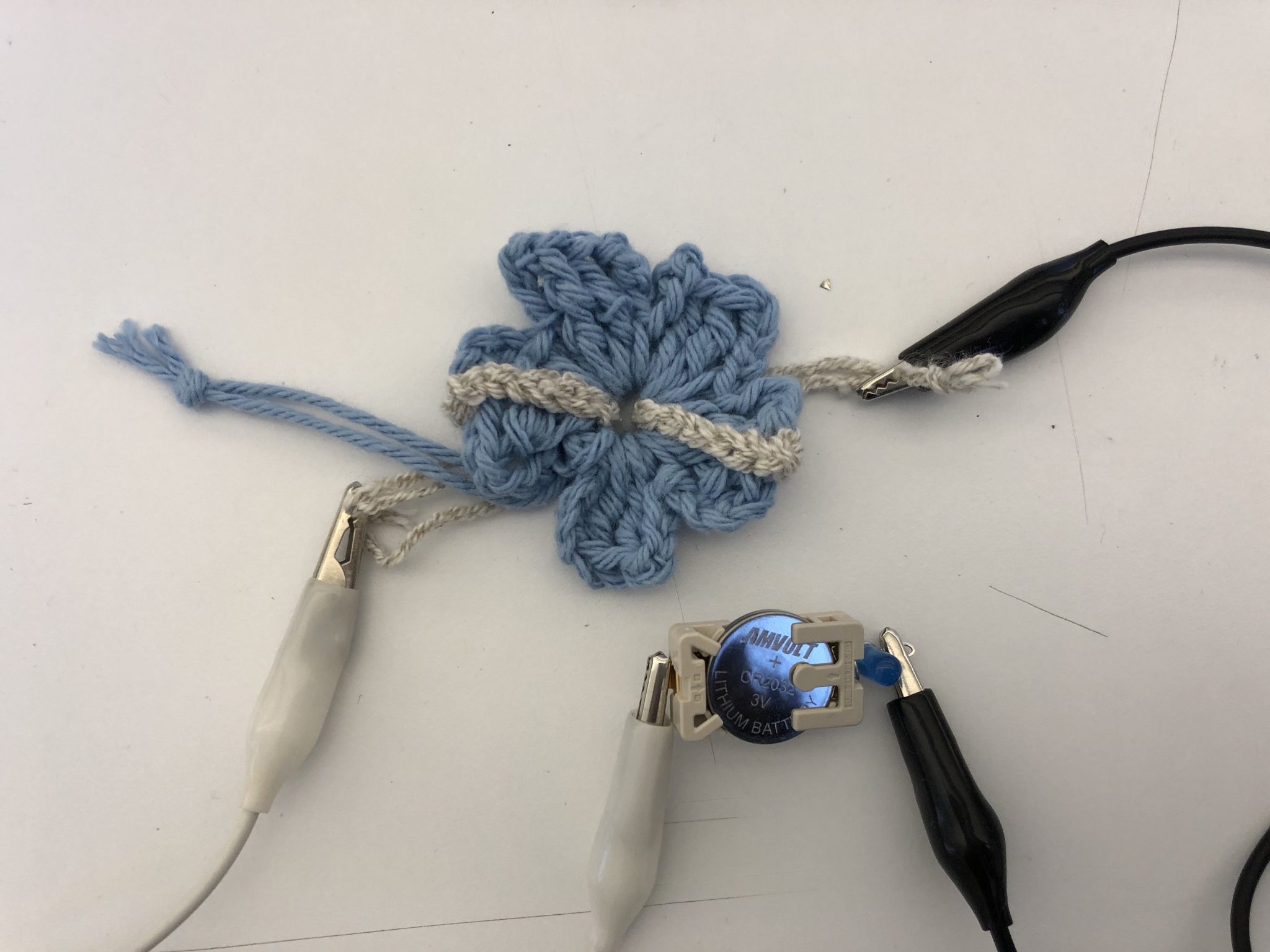
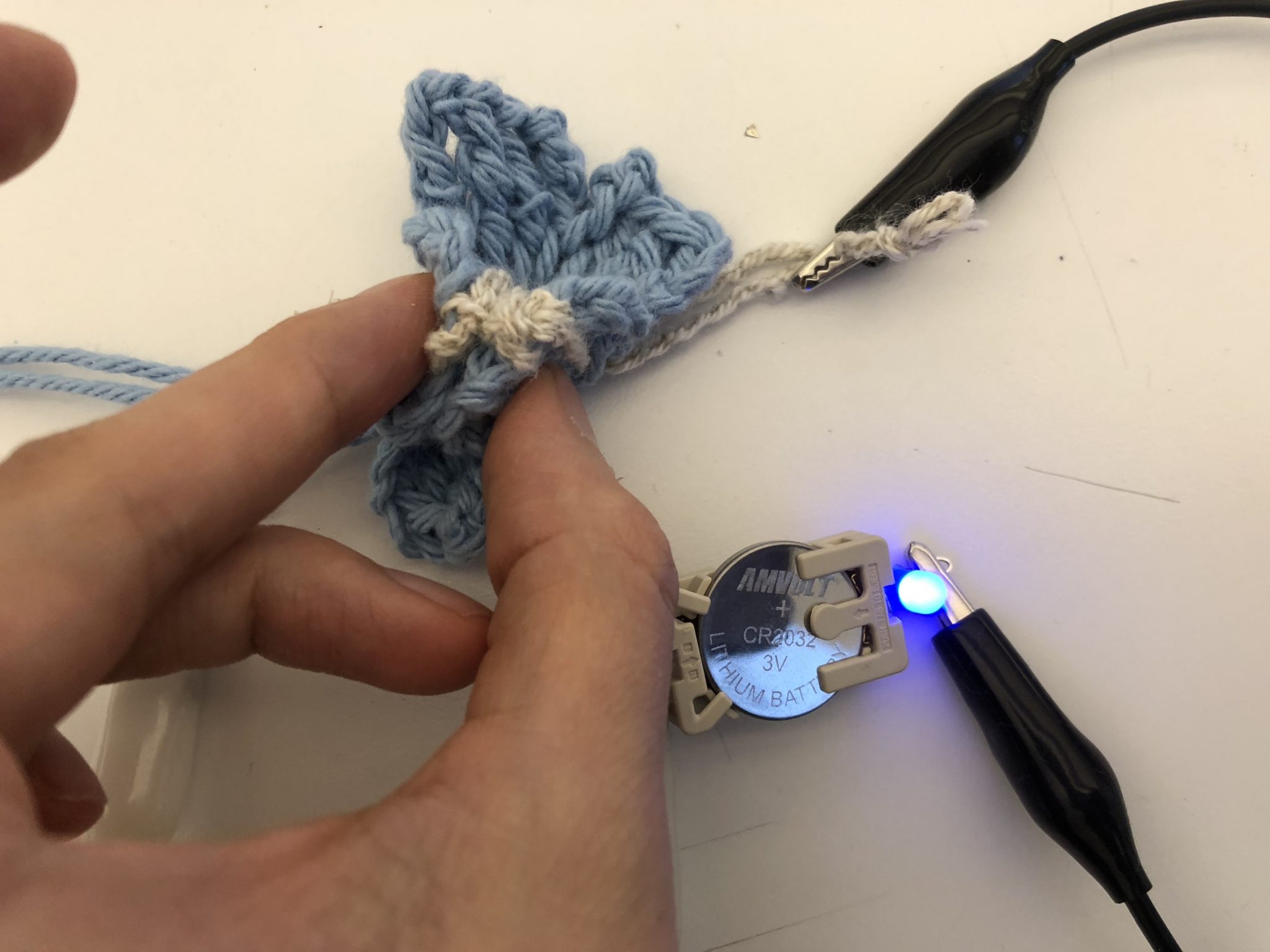
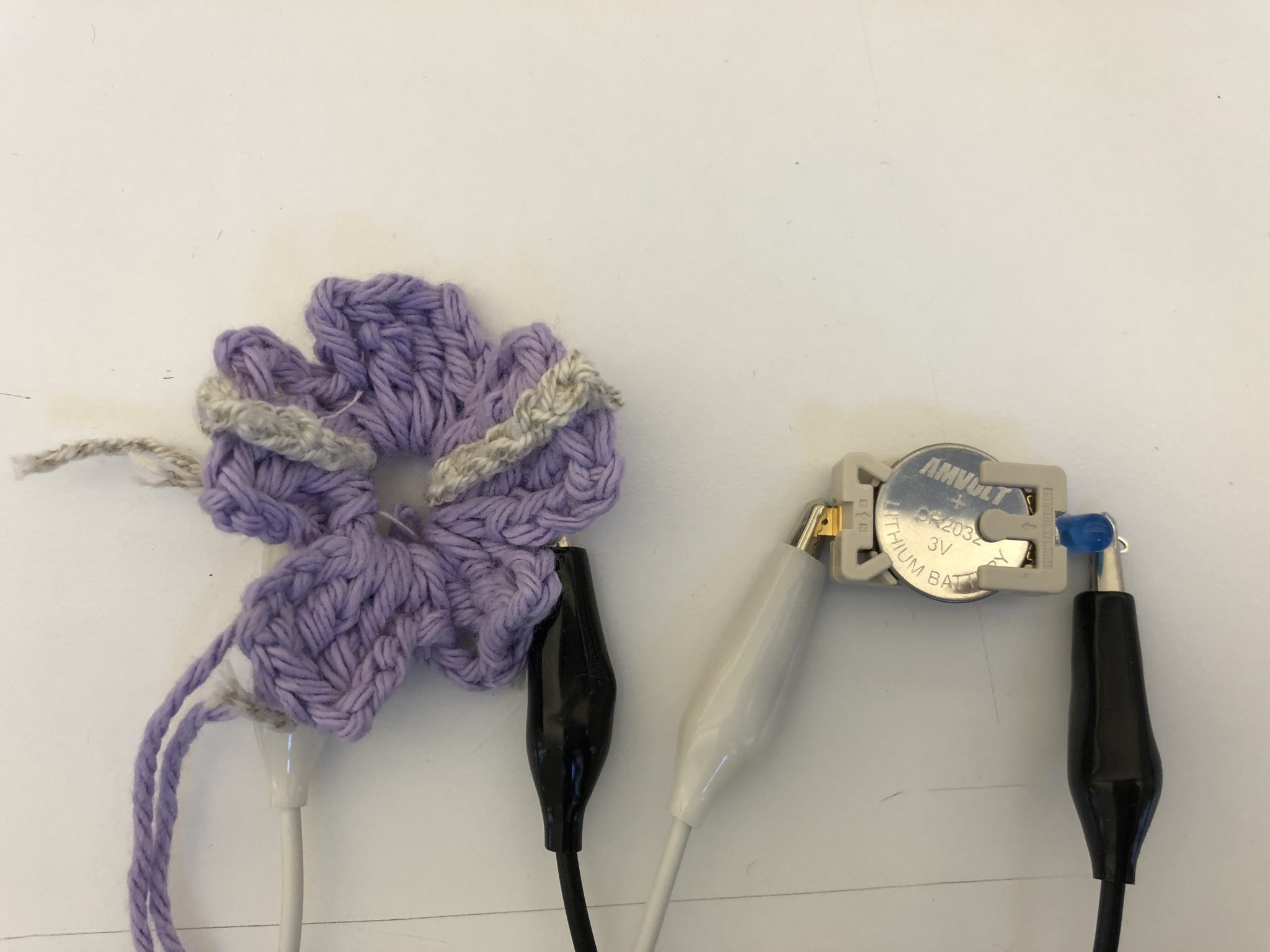
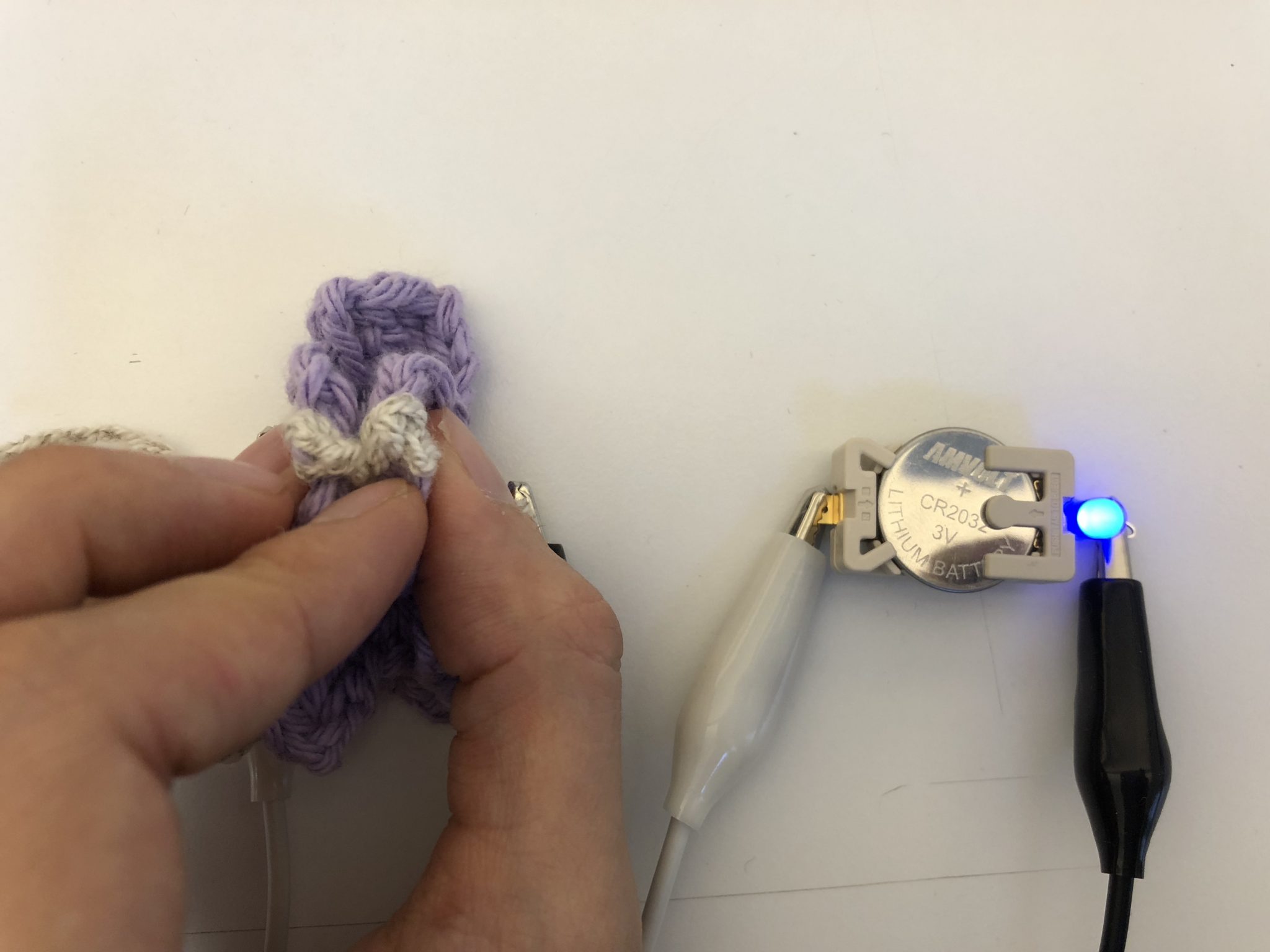
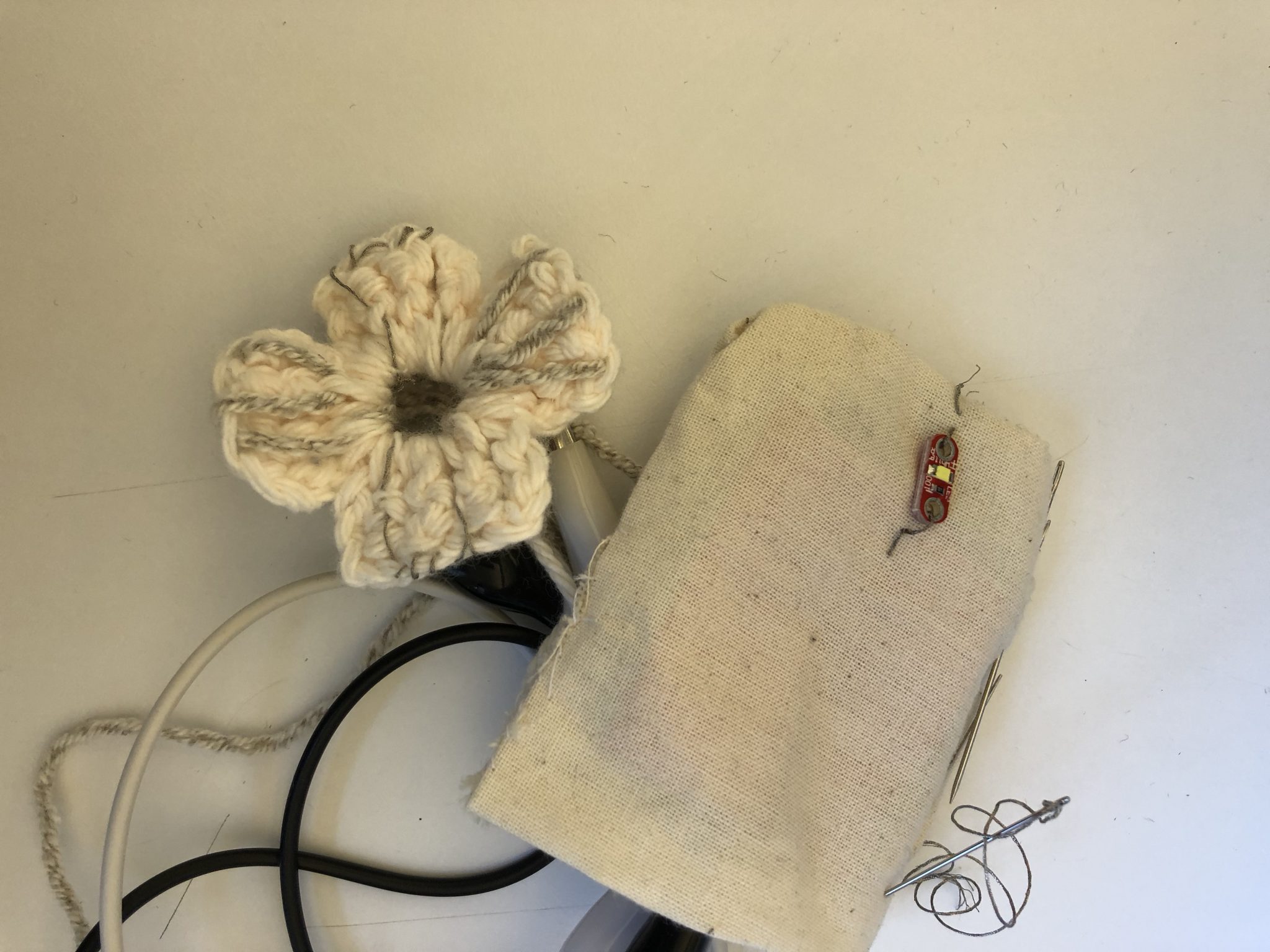
Description. I used crochet to fabricate the swatch which is shaped like a flower. I wanted to have a flower that could have two different states, open -> bloomed and closed -> bud. When the flower is closed and both sides of the conductive yarn touch, the testing circuit is closed and it lights up an LED.

Materials. Color yarn, crochet needle, conductive yarn. Testing circuit: led, alligator clips, sewable battery holder and 3V battery.

Technique. I used the colored yarn for the base flower using the simple and double stitch, and conductive yarn using the simple stitch to create an attachment to the main flower that could create the connection between both ends.

References.

https://www.instructables.com/id/Amigurumi-octopus/

I wish, one day, I could do something like this:

https://www.ravelry.com/patterns/sources/mathematical-intelligencer-june-2001/patterns

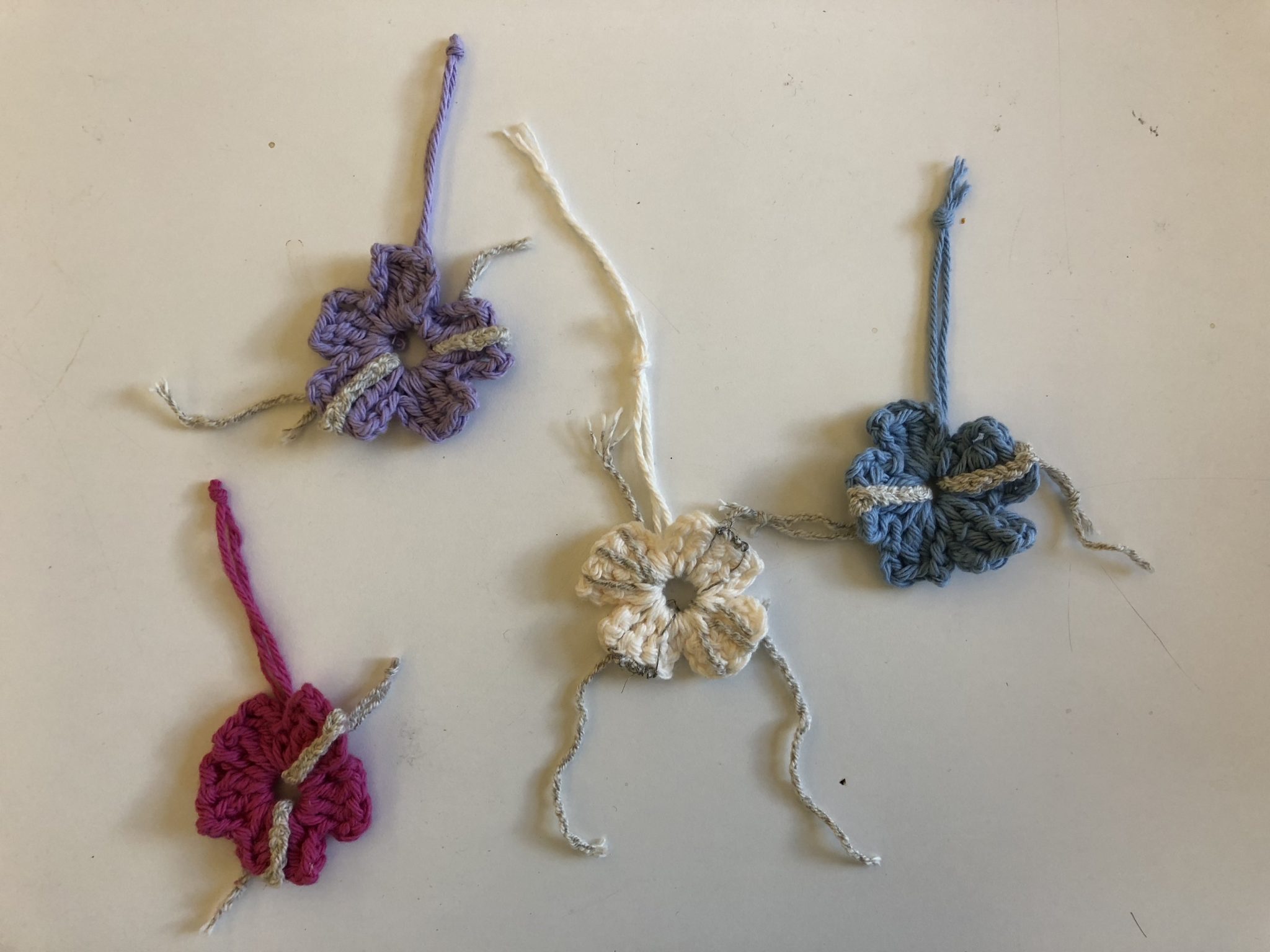
Make three more identical ones.

I created a series of flowers. The three colored ones are part of the swatch exchange. The white one, slightly different has a little bit more of experimentation using different stitches and materials ( conductive yarn + conductive thread). I can totally tell which one was the first and which one was the last one!

PART 2: Learn a New Craft 

I learned how to crochet. It’s something that I always wanted to do and I decided to use it as the main technique for my swatches too.

I identify myself as a designer, maker, researcher and educator who tries to simplify complexity by making stuff and experiences.

My favorite digital tool is still a Wacom that can work as an extension of my own hand as I’ve used it since I was a child. However, as I’m doing a lot of fabrication stuff I may have soon enough one new favorite tool.

I really liked trying a new technique with a material that wasn’t new at all (yarn) as I’ve knitted before a scarf. I found interesting that what was supposed to work theoretically at the end required a lot more time, and practice than expected. I personally found frustrating not being able to read the crochet patterns even though I was starting to feel comfortable with stitching.

I also decided to try different ways to make the swatch and I choose the one that worked better. Here an example using conductive thread edges.


TIP: I found easier to learn crochet by watching a video with the basics and then going back to the written instructions. The combination of both made me understand everything better.

Week 3 & 4 – Erica

The switch I created is called ‘Fold-n-Twist.’ The switch will turn on the LED when the user folds and twists it back and forth. The materials I used are fabric, yarn, conductive fabric tape, and threads. I bonded two layers of fabrics together first to make it stronger and thicker. Then I place the conductive fabric tape on both sides of the fabric and they have to be uneven. Lastly, I sewed the yarn on top. The LED will not light up when the user is just folding the swatch because the yarn covered the tape, so the twisting movement is needed.

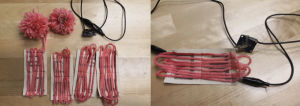
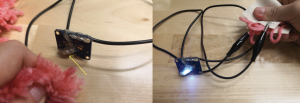
I tried to create a conductive pom pom at first but it didn’t work well, and the LED is really dim. Maybe the yarn is reducing the conductivity of the conductive thread.

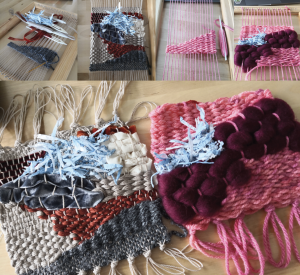
The new craft I learned is creative weaving. I’ve tried basic weaving before and I really want to try making creative swatches where I use many different types of materials. I like how the outcome is spontaneous. So I used all the scrap pieces of yarns and ribbons I have at home and I made two swatches. It was harder than I thought because it is hard to line up materials of different thicknesses. My advice will be plan a little bit before starting even though this is supposed to be creative and spontaneous.

I identify myself as a designer(clothing – not fashion), craftsperson, and a semi-artist (lol). I’ve been using these terms to describe my practice for a while now. Working with my hands comes in natural for me and I am usually pretty OCD about the craftsmanship of my work. My favorite tools are my hand and the sewing machine. I am really glad that my hands are somehow pretty ‘tools-friendly’ and they work really well with the sewing machine. The two can create beautiful things together.

Week3&4_Yixun

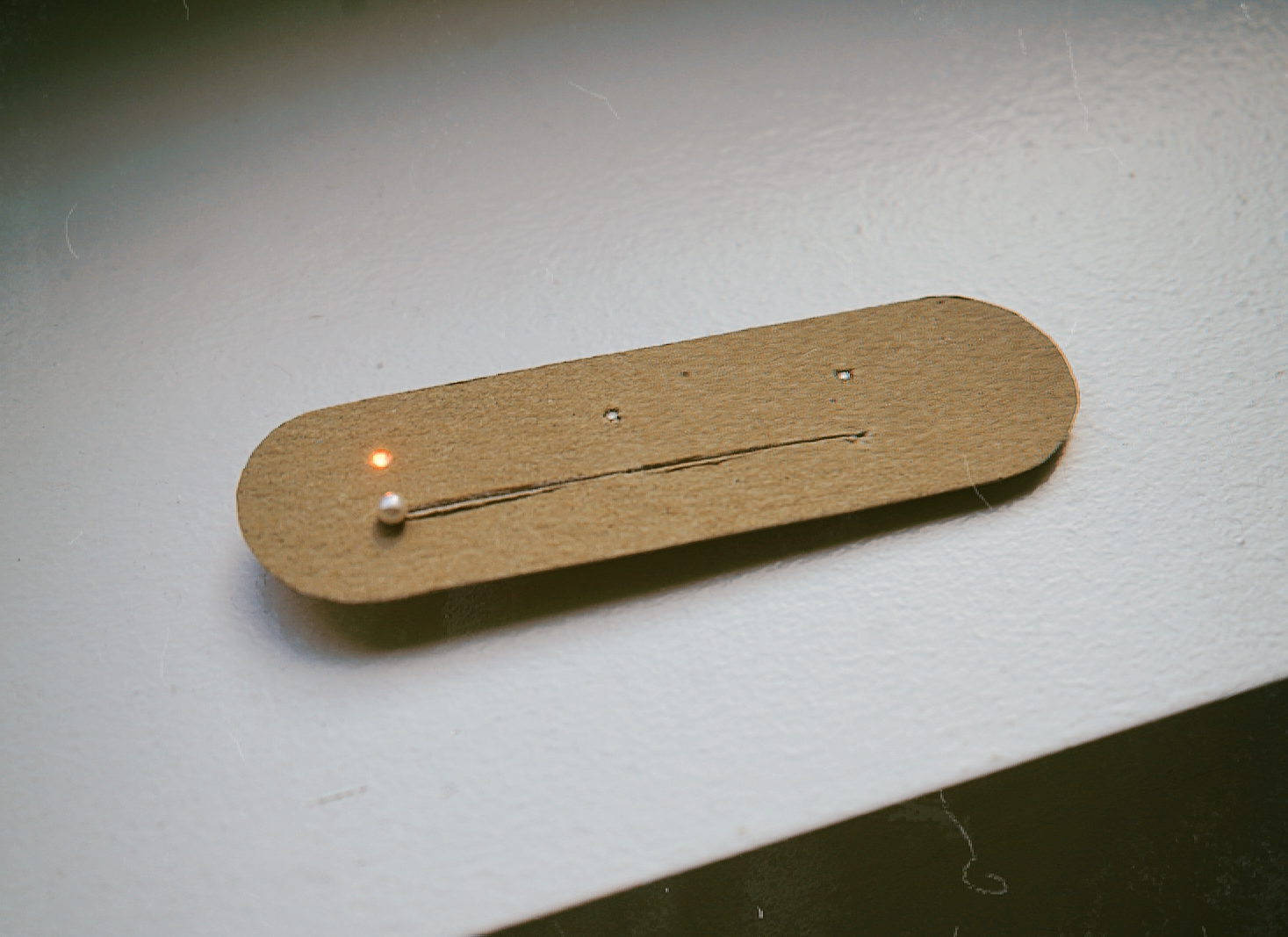
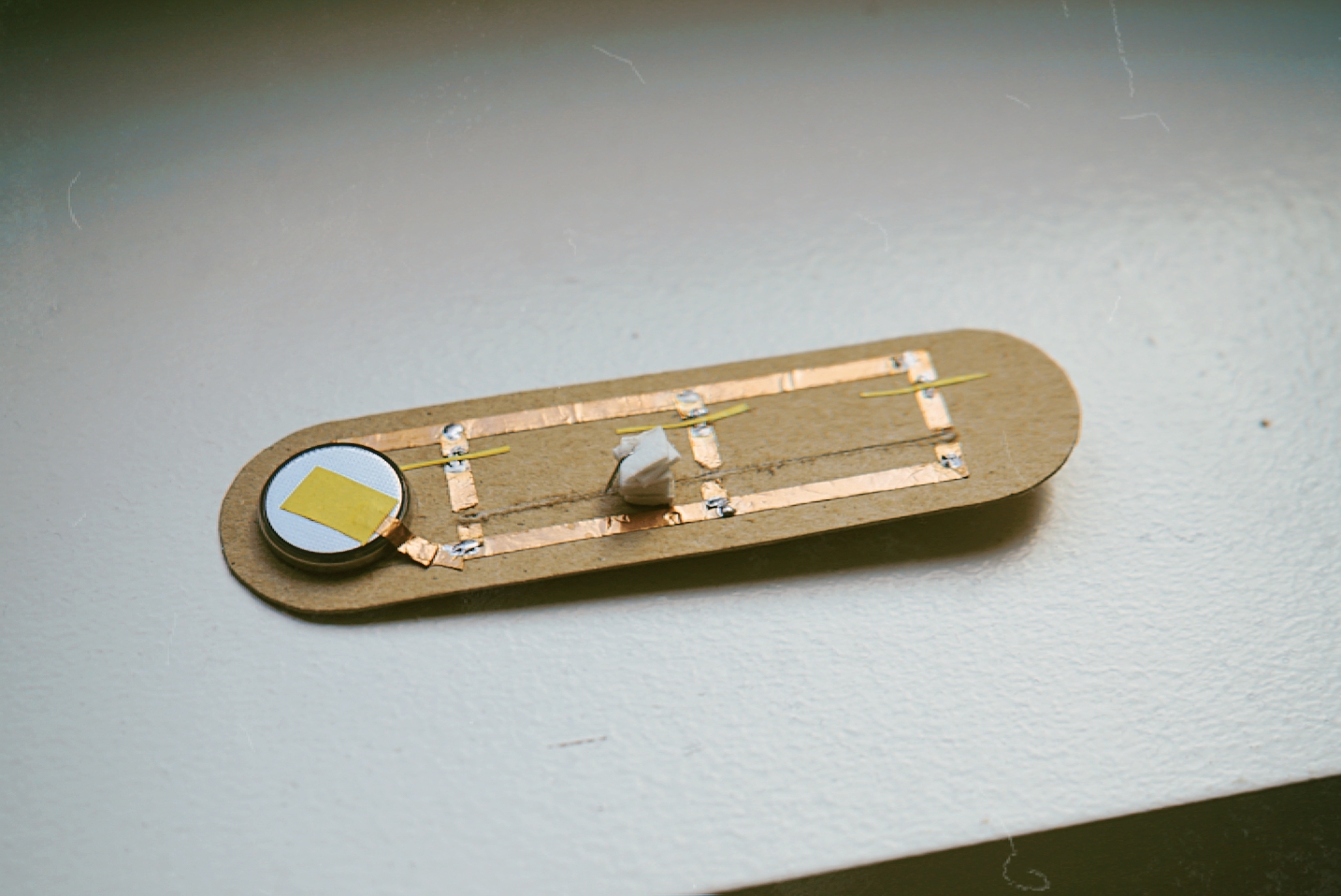
Pearl Switch
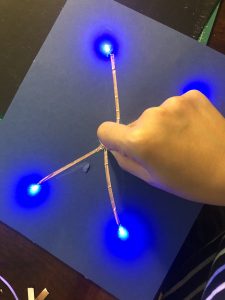
This is a switch that the users can move the bead to different positions to turn on different LEDs. I used LEDs, paperboard, conductive tapes, pins, and foamed plastic. The pin is the trigger in my swatch. And the foamed plastics are stuck together to hide the needles of pins. I soldered 3 LEDs in each swatch. I got inspiration from arcades. Some old game machines have this kind of mechanism.

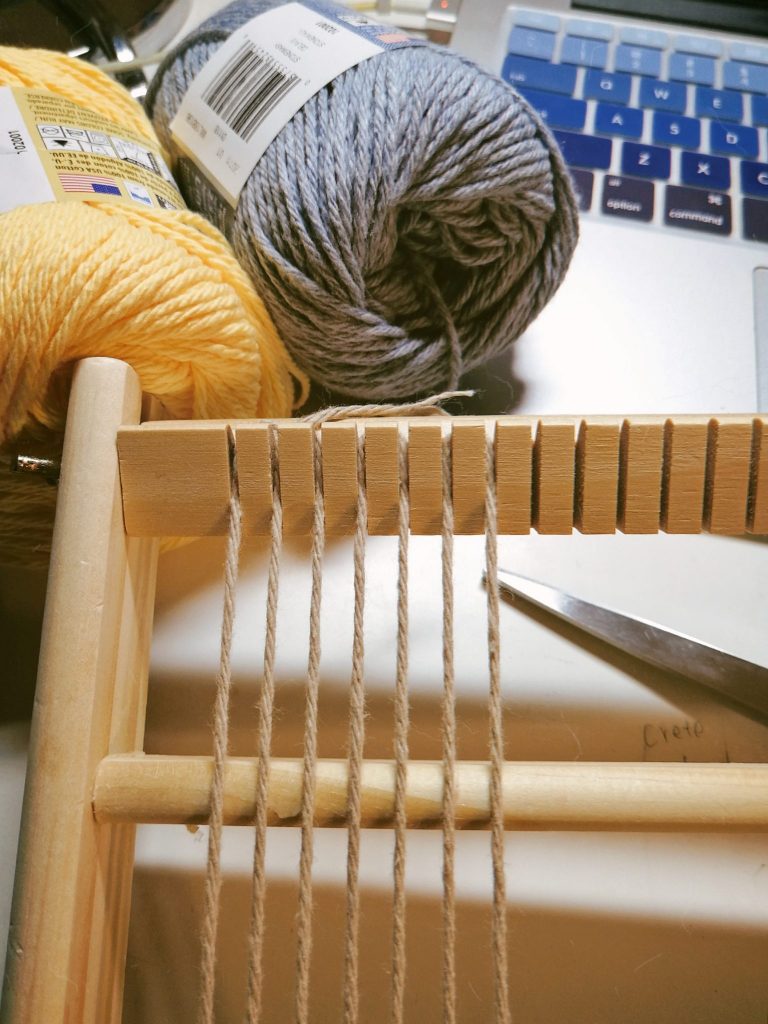
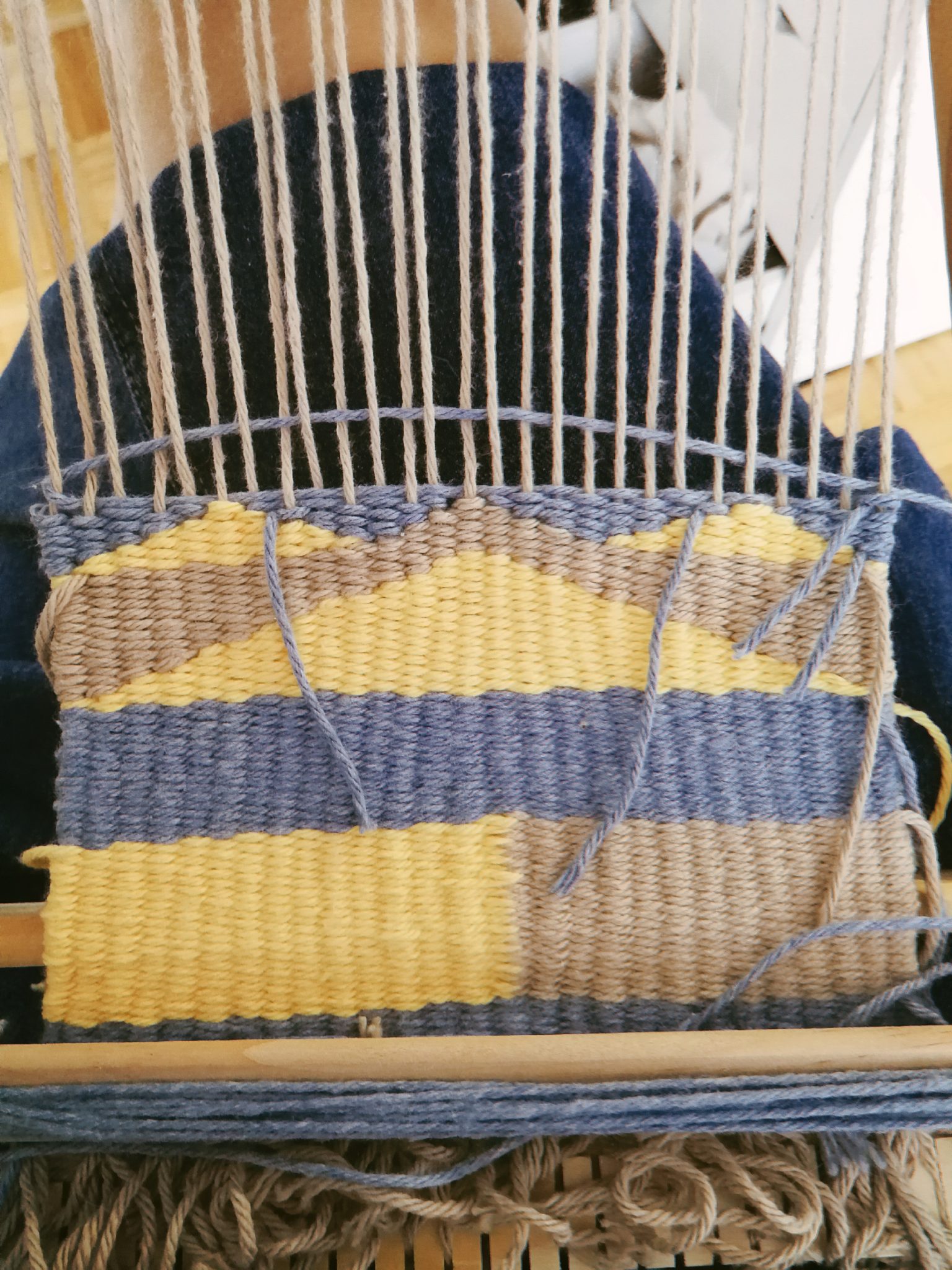
I learned how to weave by making use of a mini weaving loom. Maker, designer, artist, learner, craftsperson, and practitioner are the labels I gave myself during the process of weaving. Because the first thing I need to do is understanding the theory of weaving which is not very difficult. However, it takes time thinking about how to make different patterns instead of just rectangles. My favorite tool is my brain for now. And doing the creative jobs is the most exciting part of the making process. I realized the tricky thing about weaving is not how to make pretty patterns but how to hide all the thread residues to finish a piece.

Tips: Make sure binding of yarn and loom is tight enough or you will find all the yarns become loose in the end.

Fabric Sensors & Learning A New Craft (Weeks 3/4)

Part 1:

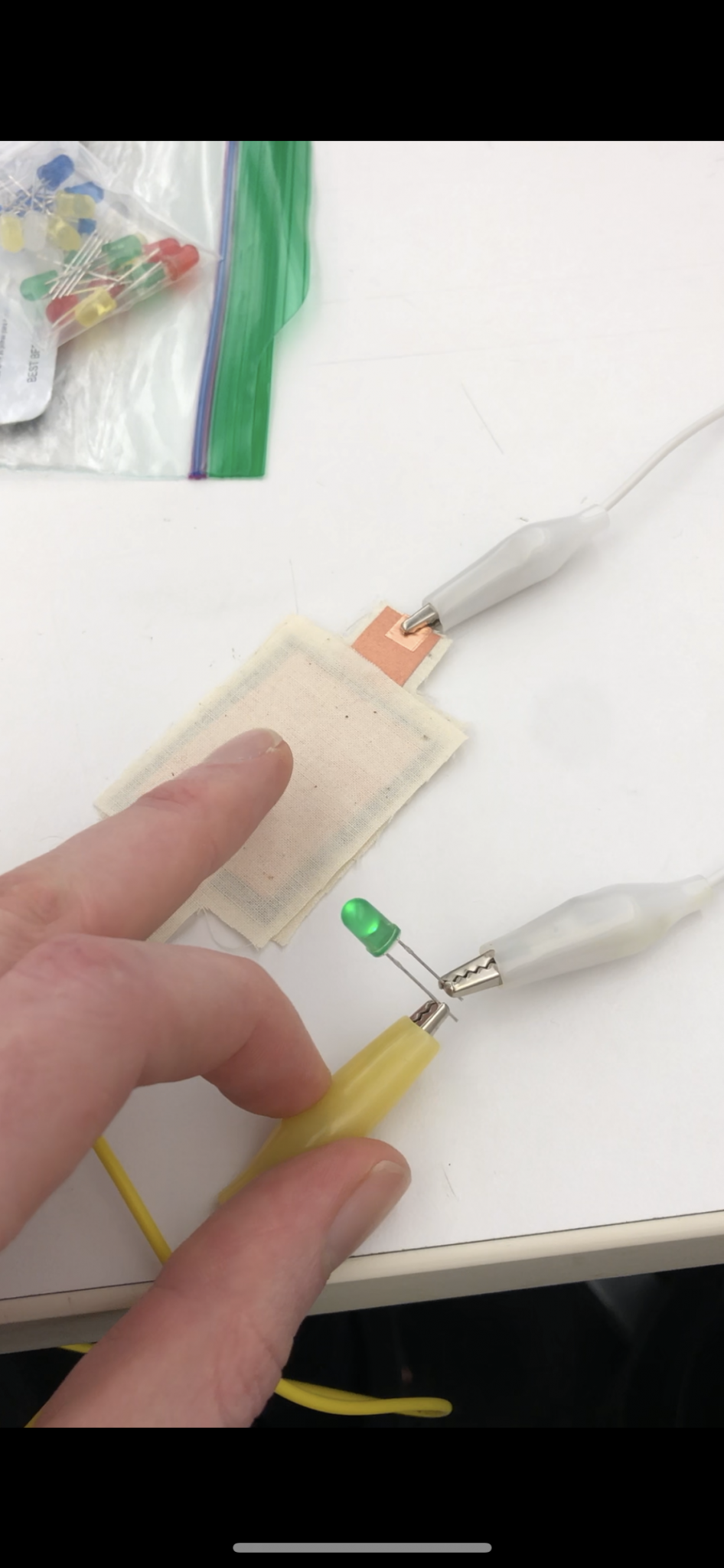
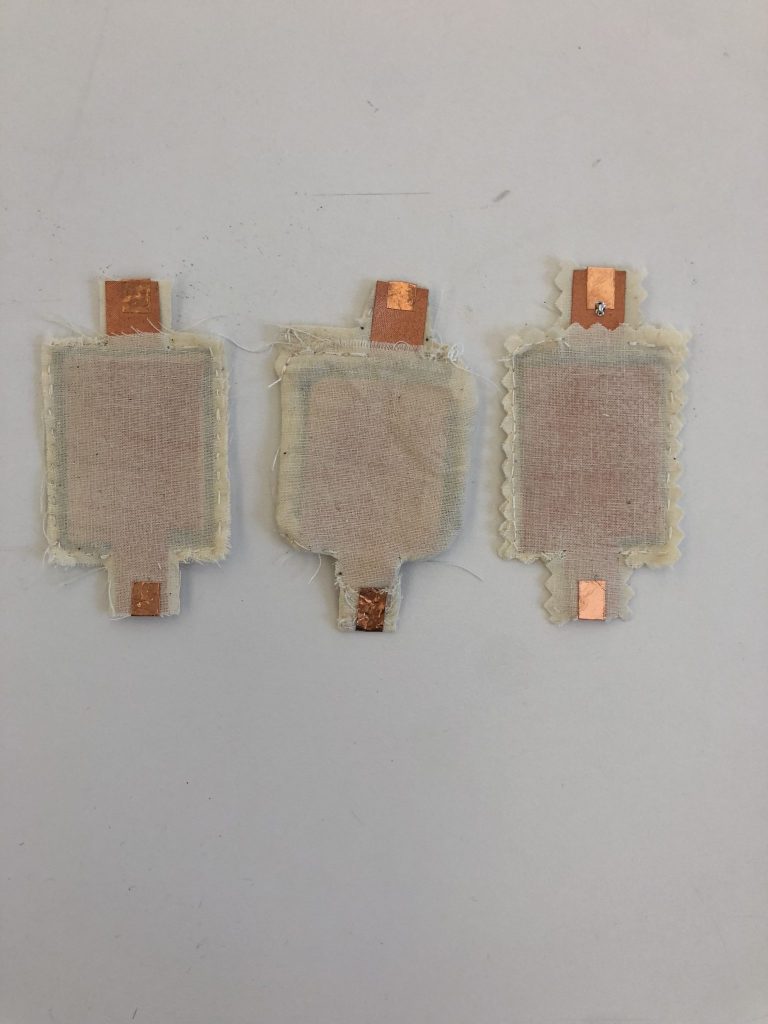
Fabric Pressure Sensor: Made from muslin, thread, conductive copper fused, velostat, copper tape.

I constructed this sensor by sewing two pieces of velostat between muslin with copper fused to each side. I followed the general idea on this instructable quite closely. I modified the shape and I used pinking shears to finish the edges of the three swatches made for my classmates. I didn’t like just giving people swatches with unfinished edges, but using the serger on such small swatches seemed like overkill. I experimented with keeping the raw edges on the inside of the sensor but the sensor was too small to turn it right-side out and not possibly damage the conductive material.

I also tried to make a linear potentiometer out of paper, copper tape, and graphite paint from Guerra paint. After a few hours of trying I could not figure out how to complete the circuit. I like the potentiometer as a sensor, I have no idea why, so I want to continue to try to make this work.

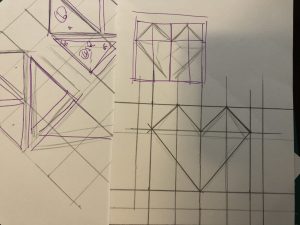
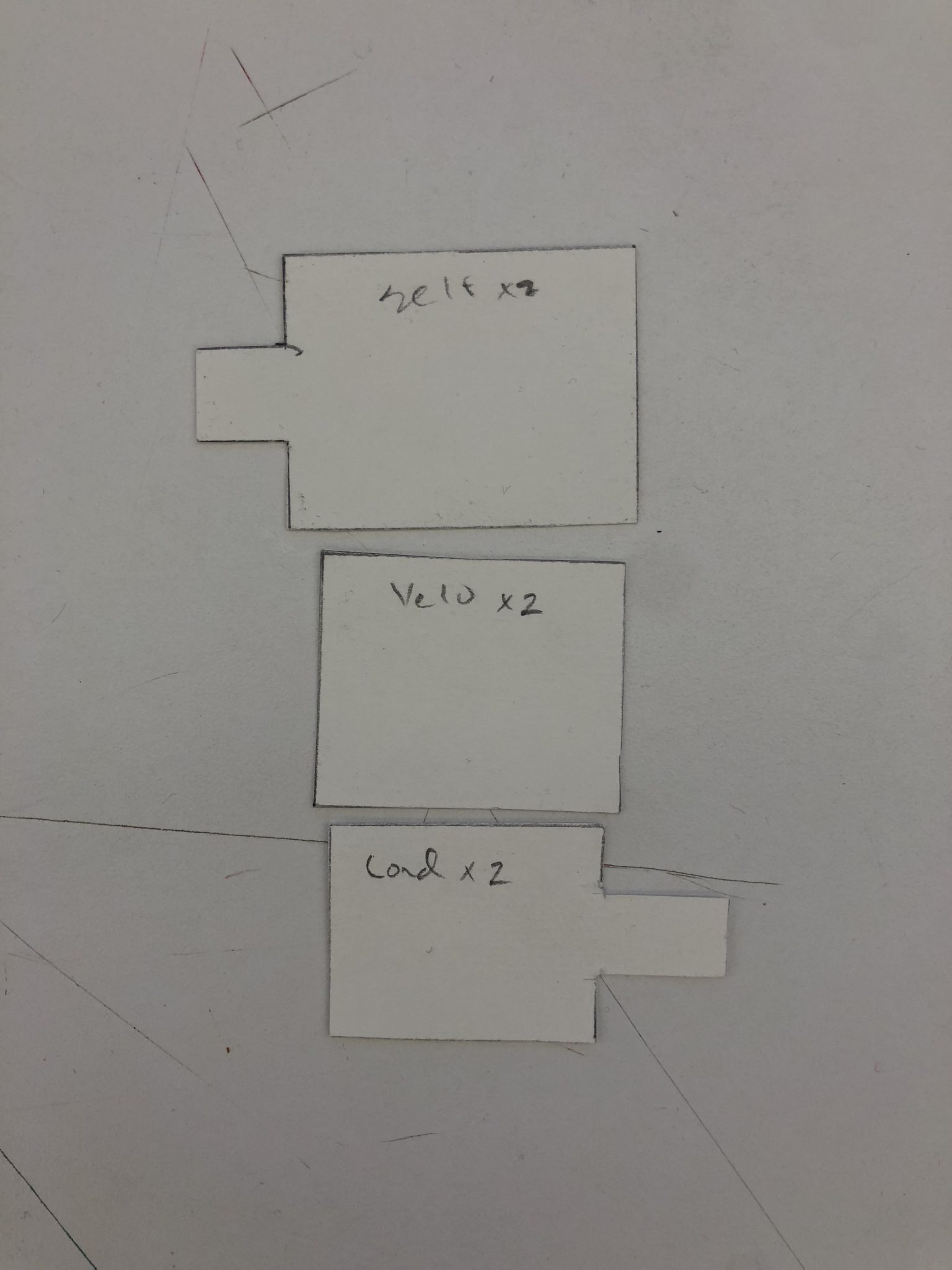
The first picture is of the progression of my thinking about how I would like to make a pressure sensor. The second are my pattern pieces. The third was my first test of the pressure sensor working.
Part 2:

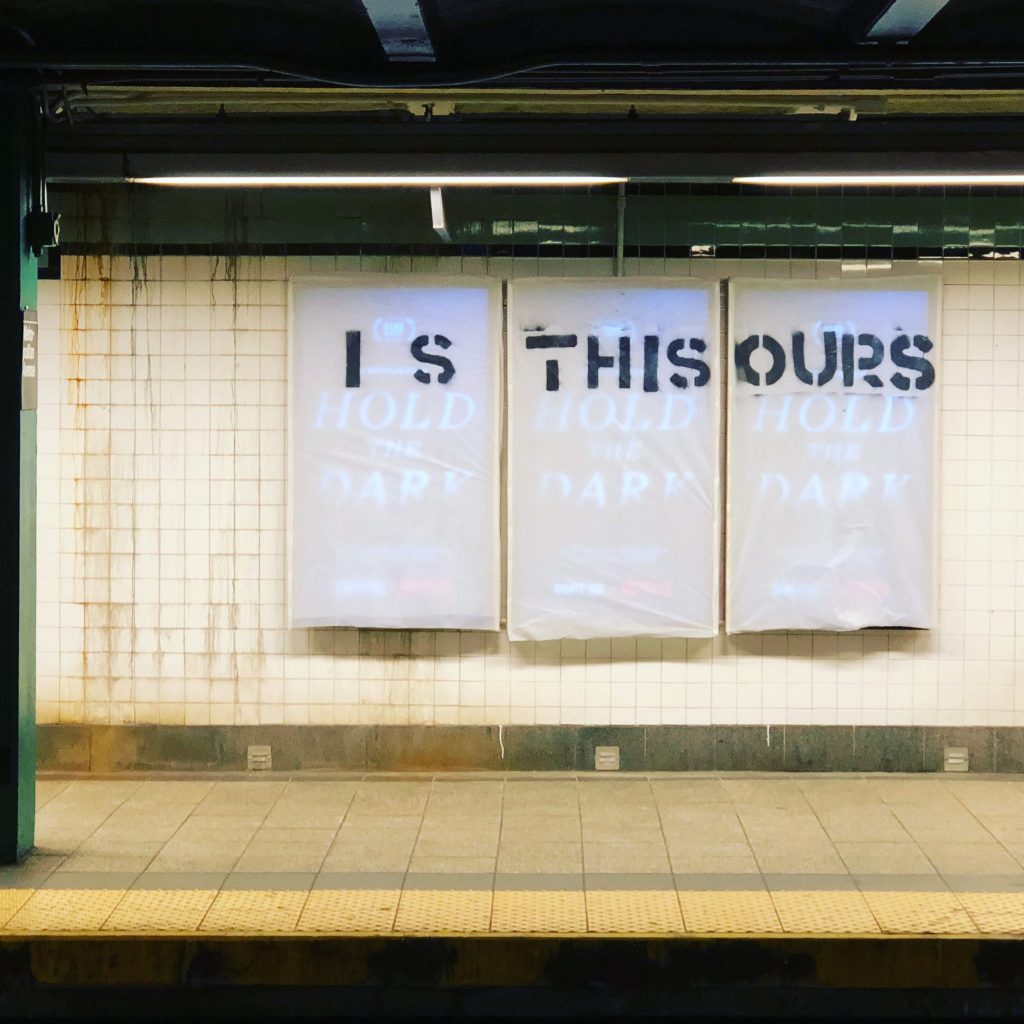
The craft I chose to learn was woodworking. Woodworking is something I’ve been interested in for long time so this was the perfect opportunity! I also was able to combine this with my 3D project for Ideas In Form. It was nice because I was able to get pretty into basic wood working principles. I used band saws, panel saws, table saws, chop saws, and drill presses to create hinged frames to hang on top of digital ads in the subway system. Attached is a picture of the frames installed in the subway.
I would classify my practice at the moment as an artist, hacker, designer, and craftsperson. The art for me comes first with hacking, designing, and crafting working in service to the art. I imagine as I become better at the physical, and digital making of things I will feel less like a hacker, but maybe not. The feeling of being a hacker may depend on the type of art that I am making.

My favorite new tool is DEFINITELY the table saw, it’s such a versatile tool, and while it looks scary, and is dangerous, it is so so SO useful. I loved working with it. The smell of the wood shop is also one of my favorite smells. I would still say my all time favorite tool is still my mind, and its ability to always learn new things.

I love learning a new craft and woodworking was no different. New crafts always have this habit of changing the way I view the physical world around me. I am now so much more aware of how wooden objects I see could possibly be made. I have to say the entire process was very pleasurable. The only thing that was frustrating was how clueless I felt the first day working in the shop. It’s been a while since I felt totally helpless in a workshop and it’s not a feeling I relish. If I were to give anyone advice about woodworking, I would tell them to plan to spend double the amount of time they thing is necessary on their first project. Everything takes forever when you’re new.
 

Week 1 – Lisa Ho

This is an Interactive Light Painting that was done by Jie Qi which when you blow on the white puffs, the seeds will grow and generate into new flowers. This is done by using LEDs, microcontrollers, and copper tape. I love how this project seems so clean and beautiful but requires such complexity into the circuits behinds the painting. And I also wonder what they used to sense the users’ breaths to trigger the seed’s growth. I’m intrigued by how you can make a simple painting like this and change it to a painting with this many dimensions. It becomes a fun piece to interact with!
Detailed Project Details can be found on her blog here.

Week 2 – Artificial Heart – Lavonne

I was so touched when I read the quote

“The little boy robot in Steven Spielberg’s 2001 film ‘A.I. Artificial Intelligence’ wants to be a real boy with all his little metal heart”

 in <Outing A.I.: Beyond the Turing Test> by Benjamin Bratton. 

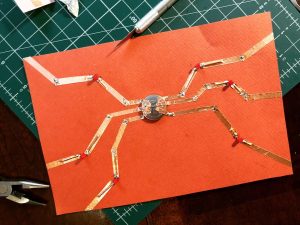
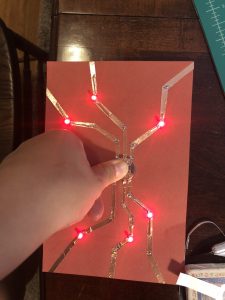
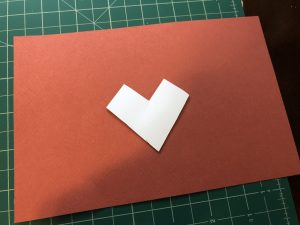
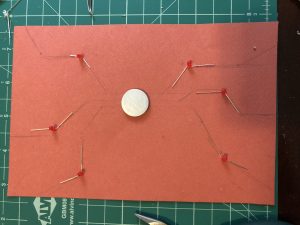
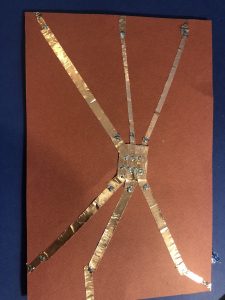
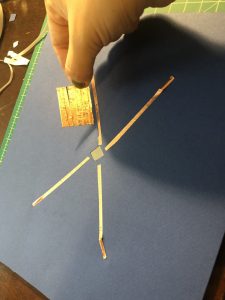
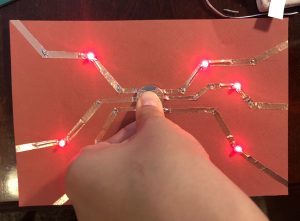
In this project, I want to use the red led light to represent the emotion of love,with the copper tape compose a geometry and electronic-path-like pattern, to abstractly be a metaphor for the metal/ machine-made heart. When you press the battery, the led light up, making diffuse reflection against the pink red paper in the background, mimic the feeling of longing for love.

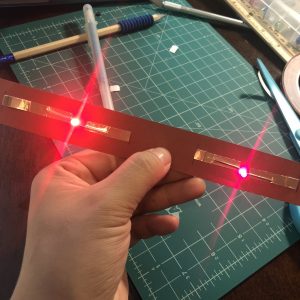
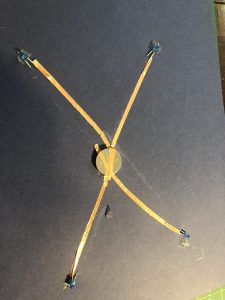
I explore the effect of how to work with paper and place the led to provoke an emotional vibe and feeling. Also tried to add blue led at the four back corners of the front main paper to mimic a feeling of emit the signal, try to add more feeling of the sense that it’s a non-organic creature.

【Process Documentation】

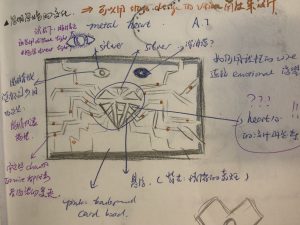
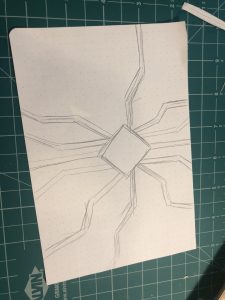
Started from the very beginning of concept sketching:

Tried different small scale samples to test the property and effect of the led light, compared with different background colors;


tested how many leds can be powered by one single battery; [it’s fun >▽<]


place the led the sketched places:

back of it:

tried out the blue leds:


Final:

Week2 Shenyue Wu

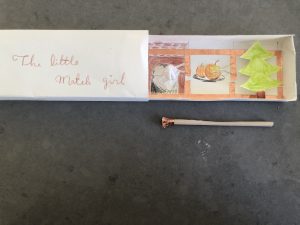
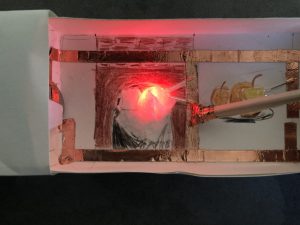
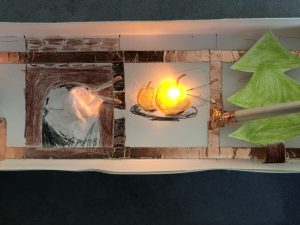
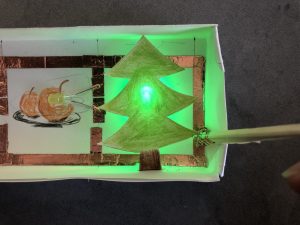
I was inspired by the children story The Little Match Girl by Danish author Hans Christian Andersen. I designed my project to be a match box and divided it into three parts. We all know that in the story, the girl lighted a match several times. The first time she saw a fireplace, which represents warmness. The second time she saw a plate of food. The third time she saw a Christmas tree. The three parts of my match box show those three scenarios in the story.

How it works is imaging you are the girl and hold the match included in the box. When you touch the point in the first part, you will see the fireplace lighting up with red light. For second one, you will see the food lighting up with yellow light and for the last one, you will see the Christmas tree lighting up with green light.

Week 1 – Neil V. Techapanichgul

In this video, they used painting as an interface to play a music. This is fascinating because you can now have more sense to play with. Normally, we just use one sense to perceive. For Example, an eye to watch a painting. I’m really want to try to use as many senses we have in future projects to enhance interaction experience. If we can use visions, sounds, and scents, our experience with any interaction will increase and more memorable than the other medium.

You can narrate your story through painting and sounds which I love to experiment with.

Project By sab