Category Archives: Assignments

Week 2 Assignment

Pick sentence or passage from a story that you like (children’s storybooks work VERY well), a song, a poem, etc that you like. Illustrate part of that narrative using a parallel circuit with 3 LEDs and materials we discussed in class.

Please focus on the construction and aesthetics. Think about how you will use other materials to diffuse your LEDs. Ideally, I would like the circuit visible in your illustration. Consider how you can use the aesthetic properties of the materials to design a circuit that is fully integrated into the illustration – not just a circuit on the bottom with a piece of paper on top.

Post documentation to the blog and bring your final product into class.

Here are a few examples from past classes:
These do not embed the circuit into the illustration, but are still very successful aesthetically:
Where the Wild Things Are, Vivian Lee 2017
Sublime Light by Sofia Aronov

These do embed the circuit into the illustration:
My Neighbor Totoro by Hayao Miyazaki, by Chanel Duyen 2017
Hug Me by Misung Kim
Ray Bradbury quotation by Eliza Bruce
Week 1 – Dario Narvaez

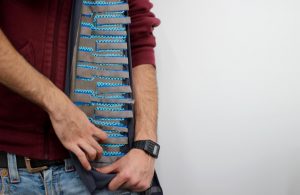
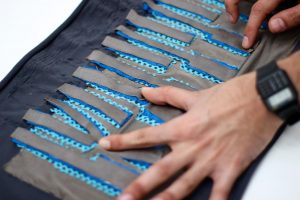
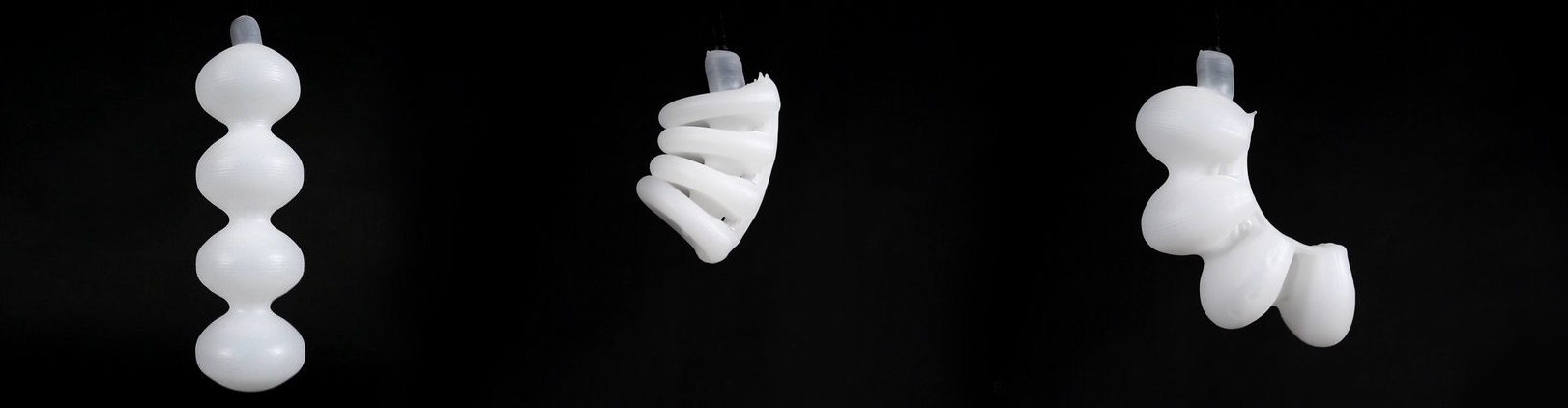
Liquid Printed Pneumatics

Image taken from Self Assembly Lab website

This is a project developed by the Self-Assembly Lab, a group of MIT researchers interested in exploring the properties and possibilities of programmable and smart material, as well as soft robotics, with the goal of re-inventing the way artifacts are manufactured today.

Although the material presented in this example requires a specialized process that is not yet available for market access; It can give us a glimpse of what the field of programmable materials with different properties, can provide us for future applications.

In this project in specific, the Self-Assembly Lab explores the properties of elastic materials (printed in 3D as silicone or rubber) with pneumatic (inflatable) abilities as a catalyst for the creation of new forms, postures and experiences: “4D structures that adapted according to function, performance and aesthetics.”

Self-Assembly Lab partnered with BMW to look for innovative solutions to apply in car interiors that can mutate and transform according to the specific needs of the user. The results in research in this field, can open new possibilities in other areas such as: architecture, aerospace, adaptive products, appareal, etc…

Self-Assembly Lab Team: Bjorn Sparrman, Shokofeh Darbari, Rami Rustom, Maggie Hughes, Schendy Kernizan, Jared Laucks, Skylar Tibbits

BMW Team: Sophie Richter, Akos Stegmar

Week 1 – Anna Garbier

I recently saw (and touched and heard) Tactile Orchestra at Cooper Hewitt’s “The Senses: Design Beyond Vision” exhibition. The installation is a soft, furry wall that– when stroked– plays part of an orchestra. Depending on the exact movement and location of your touch, different parts of the orchestra play; the more people stroking the wall, the more sounds that are played.

I loved the childlike simplicity of the interface and the fact that it allowed multiple, simultaneous interactions: both humans-to-wall and humans-to-humans. I felt like a kindergartener, surrounded by other kindergarteners, with my arms stretched out experimenting, playing, and exploring.

Week 1 – Zhenyuan(Christina) Shi

I’m very intrigued by this interactive mural project because it preserved how graphically satisfying it is and then added interactivity based on that graphic design. In the project they applied soft conductive materials — conductive paint and copper tape. Then they connected different parts of the mural to an electronic board which would tell the projector to project different motion graphics onto the mural.


Week 1 Assignment – Adam Moore

I am very drawn to the piece Contours by Alicja and Fabio. Installation art that uses technology but is not specifically screen based is what made me interested in attending DT in the first place! The ability of technology to be incorporated into the physical environment is, for lack of a more erudite word, MAGICAL. Technology can make something as intimidating as installation art into a much more friendly experience because the viewer is able to physically interact with the piece rather than remaining passive. Installations that are interactive have the potential to be a gateway to a greater appreciation of art for people who are ordinarily intimidated by it.

Below is a video of Contours in action. Enjoy.

Week 1 – Carla Molins

This project is part of a textile design students at MOME – Moholy-Nagy University of Art and Design performed by EjTech. It consists of different systems compound by sensors that play music/sound. The uniqueness of this project relies on its materiality, all natural materials, fibers, leaves, and some other elements that make this technological project break the barrier between nature and technology. I find it both poetic and visually compelling.

There is a wide variety of hand-crafted sensors made of textile in addition to different natural materials coming from different plants and vegetables.  Of course, I couldn’t try it and feel it, but it seems to me that it has to be really smooth and satisfying. I love every bit of this project! I’d like to try to work with natural materials combined with other synthetics that makes the interaction viable, efficient and reliable. It’s highly experimental, but I’m willing to explore new ways to play with senses and haptics.

Artists and designers have been proposing the ideas to grow textiles as the ways to think about environmental, sustainable, ethical issues surrounding the textile production.
We propose to think about these issues including how e-textiles and smart textiles plays a role towards sustainable living, creating possible futures for second skins, sensors and adaptive/responsive structures. EjTech.


Week 1 – Erica (Yiyun)

This project is from a guest lecturer I got to know from last semester. The project is a IOT dress that visualizes the user’s daily interactions and diary entries. The diary entry is analyzed by the server through keyword tags, then the matching thermochromic paint pattern will show up on the dress. I liked the personal and abstract aspects of this project, but I was more intrigued by the tech elements of this dress. It involves elements like Bluetooth LE module, phone app, cloud server, embedded heat packs, and thermochromic paints. I am really excited for the thermochromic paints class!


Week 1_Yixun


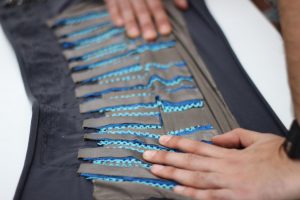
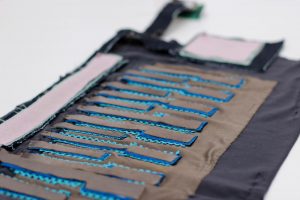
This is a project called FrabricKeyboard from MIT media lab. The fabric keyboard consists of multi-layer textile sensors machine-sewn in a keyboard pattern, and it detects different stimuli such as touch, pressure, stretch, proximity, and electric field. What I found interesting is that users can not only touch the interface to interact but also use non-contact gestures to play music. This project reminds me of another musical invention—Hand Roll Piano. With small size and low power consumption, Hand Roll Piano becomes a great portable musical instrument. Compare to Hand Roll Piano, FrabricKeyboard has made improvement in interaction design and music style that can be played.

Video:https://vimeo.com/213298236


Week 1 Assignment

  1. Get logged onto course website. Please change your username to your name.
  2. Find a project that excites you and that uses the materials we looked at in class. You can use one from today’s class or find something new.
  3. Create a post that includes, images, video, or other documentation. Write a brief paragraph explaining what it is about this project that intrigues you.
  4. Purchase materials listed in TOOLS today or tomorrow.