SpaceJunk (Week 1)

Spacejunk (2016)

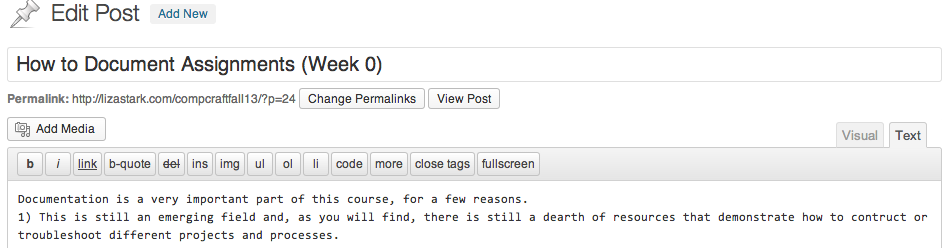
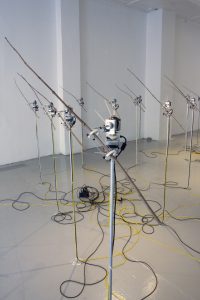
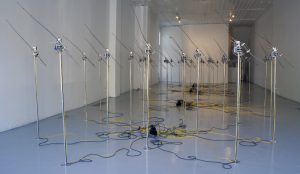
David Bowen is an artist whose work, from both a technical and critical standpoint, is quite amazing. One project in particular that fascinated me is Spacejunk, 2016. This installation, originally constructed in 2015 with only five twigs, uses 50 twigs connected to motors that all point in unison towards the oldest piece of human-made space debris, such as rocket bodies and parts from old satellites — some as old as 1958. Once the debris is on the same horizon as the installation the twigs follow its movement by pointing towards its location. When the “space junk” drops below the horizon the twigs return to a resting position. What I like about this work is that the mechanics are simple enough to grasp, along with the concept, however, there is a sophistication to the work, something almost methodical. I think a large proponent of that is due to the number of twigs and the simplicity of the technological elements.

Continue reading

Week 1 – Light Kinetics – In the Loop – Carla Molins

I’m really interested in how to bring the physical and the digital world together in order to create more engaging experiences.

Light Kinetics connects the real world physics into digital in a way that is both magical and mystic. This installation creates a seamless effect of light al through the lightbulbs loop. The accuracy and the detail make it so special.

http://www.espadaysantacruz.com/projects/light-kinetics-in-the-loop

Light Kinetics is the last interactive installation of Espadaysantacruz a, Madrid based, creative studio.

In this piece, light is controlled by a physics simulator creating a astonishing effect.
A piezo electric sensor situated in the first bulb captures the force of the tap, generating a light particle that moves along the loop. All the shades of the energy are reflected in the trajectory of the light.
The system is powered by Unity 3D that simulates de forces that apply to the virtual corpuscle.

This project is a follow up of the previous experiment: vimeo.com/90523113

espadaysantacruz.com
March, 2015

Week 1: Magic Mirror

Frankly, I have no idea what I am capable of regarding physical computing. I’ve had experience with a Raspberry PI,  but “experience” is too strong a word to describe my pitiful attempt at Python and fooling with a breadboard. A better word that synopsizes my experience might be that I have but encountered the massive and interesting world of computing. One thing that always stays on my mind in regards to tech projects is practicality, and how I can implement the project and innovate it’s systems to benefit in my daily routine. Ergo, the Magic Mirror project is one I find particularly interesting to explore.

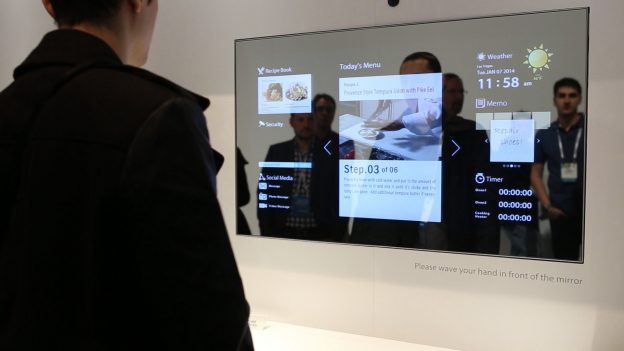
Upon initial reflection the Magic Mirror appears to be a regular mirror, but can actually feature images and text by subtly materializing onto a LCD screen behind two way glass. Via remote connection to wifi and Raspberry Pi to a main PC the user can exhibit weather forecasts, calendar, notes, and essentially anything provided the effort and configuration. I’m very interested in learning how to remotely connect my PC to a third party LCD and explore the overall schematics of the Raspberry PI interface.

Magic Mirror

http://blog.dylanjpierce.com/raspberrypi/magicmirror/tutorial/2015/12/27/build-a-magic-mirror.html

Week1

The Transparency Grenade of Julian Oliver is a work that exposes the powerful invisible surveillance status of our world.
With a visually strong object he makes visible everyday hidden technologies and uses of power.
The transparent grenade contains a small arduino computer, a microphone and an antenna. When activated, the antena records the audio of a room and the information travelling wireless, sending it to a public website and exposing it.

Liliana Farber

Continue reading

Week 1 Assignment

  1. Purchase all materials (listed here) and bring them to the next class
  2. Log onto the course website. Find a physical computing project that inspires you. Create a post that includes, images, video, or other documentation. Write a brief paragraph explaining what it is about this project that intrigues you.
  3. Log onto the course slack. Share a link of the same project on the #inspiration channel.
  4. Watch/read this multimeter tutorial.