Week 2 – circuits
Leave a reply
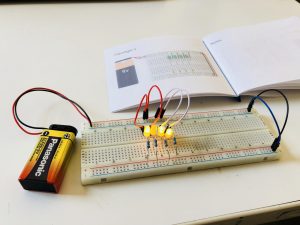
#1. Flashlight 5
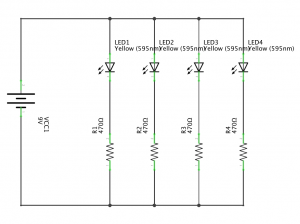
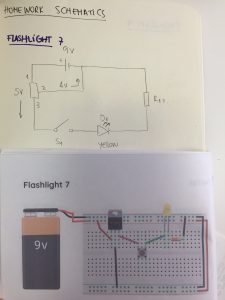
#2. Flashlight 7
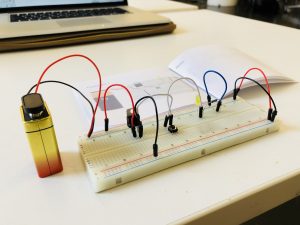
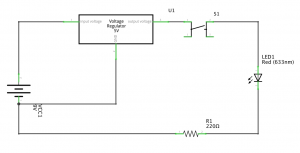
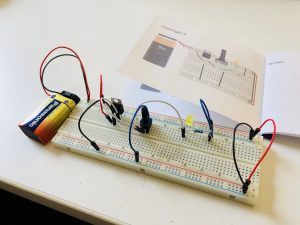
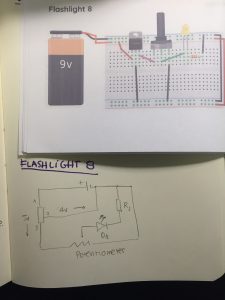
#3. Flashlight 8
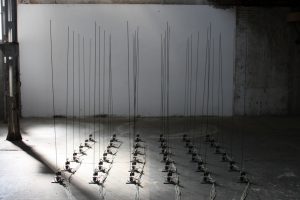
“Nemore” is a garden, consiting of 36 bendable graphite poles. “Nemore” senses the visitor. Each pole has a behavior and reacts to it’s neighbours only: and to the visitor, of course – the visitor acts an “alien neighbour”. We are interested in the question: Does a system arise from the poles behaviour, that we (the observers and the visitor) perceive as angst, curiosity, nervousness, etc.? Each pole has a distinct sound, that builds up a chord, fluctuating in resonance with the movement of the poles.
Max Kickinger describes the setup : “The poles are driven by two servo motors – one rotates the pole, the other one pulls up a coil with a fishing line attached, bending the pole. The garden is controlled by six arduino mega, a computer runs vvvv for the server application and pd for the sound. Sound works as simple additive synthesis made out of 36 sine oscillators. No sound is played, when the garden is in the “center-position” – only the irritation of the poles generates a modulation of pitch and amplitude : the wider the bending of the pole – the louder the according oscillator will sound. Pitch works in either way – up and down.
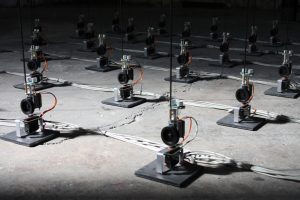
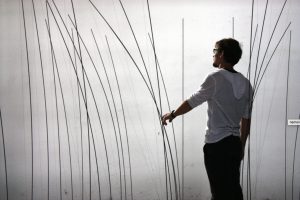
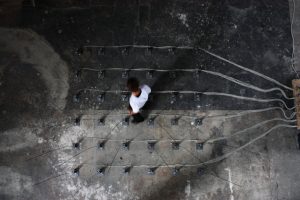
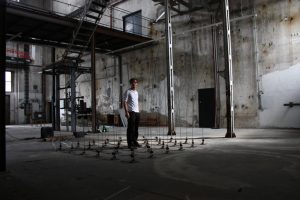 This art piece contains physical computing mechanism using movement sensor (ultrasonic? thermal detector?) to make servo motors rotate and bend the poles. In addition, each pole has a oscillator generating sounds according to the poles are bending. I am interested in sound and how its resonance affects to the space according to human interaction. Also I have an idea that “awakening our hearing sensor,” which is creating a new communication tool using variety of pitches and rhythms instead of language we are too accustomed to as much as we can easily hide or deceive our authentic feelings. I assume this “Nemore” project can be a brilliant technical precedence for my future project.
Created by “Fishing for Compliments” : Jan Bernstein, Max Kickinger, Woeishi Lean, Sebastian Neitsch
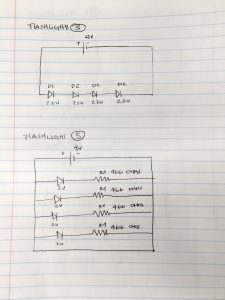
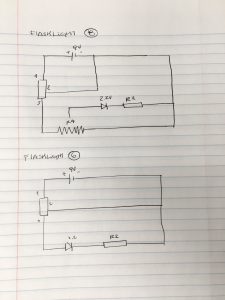
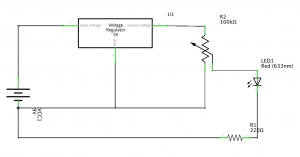
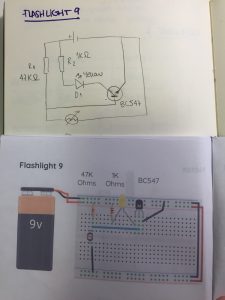
These are my 3 schematics.
I’ve chosen one with a voltage regulator, one with a potentiometer and one with a transistor.
UPDATES:
DUE BY 2/8:
DUE BY 2/15
This project is six years old, but I only just saw it for the first time. Still feels relevant. I clicked for the catchy name. I stayed for the hardware talk. Once I heard “video experimenter shield,” I was hooked. My knowledge of PComp is so limited, that this whole concept of shields is new to me.
This example showcases a video shield made by Nootropic Design. The shield allows you to feed the video signal from cable box to Arduino, which parses the closed captioning transcript for keywords. When a keyword is detected, the Arduino mutes the TV for 30 seconds via an IR sensor.
As Matt Richardson explains in the video, a world of possibility opens up when you turn your Arduino into an infrared remote control. It’s such a simple mechanism, but when used as a form of censorship or commentary, it has some real potential. Here it facilitated a conversation between cable box, Arduino, and TV, and between passive consumer/active producer by extension.
I also like that this project is explained well in the video. I feel like I could replicate this and then tweak with my own ideas.
This was one of the first projects that inspired me to find the interesting intersection and the infinite results between the analog and the new technologies. The Kinetic Sculpture: THE SHAPES OF THINGS TO COME (2008), is an installation designed for the BMW museum in Munich by Art + COM where the history of BMW is shown by animating the iconic forms of the cars. BMW’s brand recognition is given by the car silhouettes, and the sculpture efficiently highlights the pure values of BMW design and brand history.
The sculpture integrates good design, great story / concept, simplicity in the result and technical complexity (electronics + mechanics + code). This is an equation that makes an object, sculpture, experience successful.
Technical details: six-square-meters area and 714 metal spheres are suspended from the ceiling.
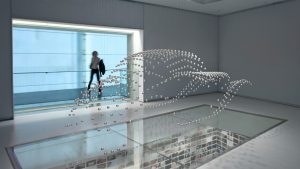
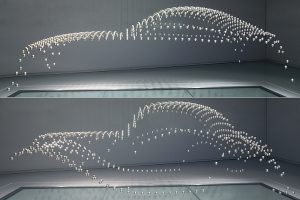
In the words of the designers: “The theme of the installation is the form-finding process in car design, which is performed in a seven-minute choreographed sequence: at the beginning the installation is in a chaotic state. No form or design idea has yet been found. The spheres move individually creating an impression of spatial white noise. Slowly the first geometric forms emerge, loosely relating to the contours of the vehicle that appear later.”
I found this interactive installation done by Arduino very interesting. It consists of 27 luminous spheres and will light up differently. I don’t completely understand the technology used in this project yet. But seeing the final effect, I feel that it can be used in many fields such as installation art and stage settings. Also, I’m imaging that if we change the output into something not only physical but also digital, the outcome will be more fun.
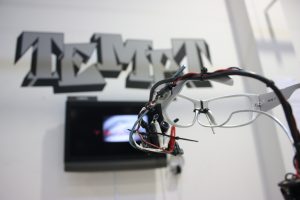
The Eyewriter
One of the first projects that I encountered after coming to DT was the Eyewriter. It uses a low-cost eye-tracking system and open-source software to allow people suffering from any kind of neuromuscular syndrome to draw by tracking their eye movement and translating it into lines on the screen. This project reminds me of the immense potential of creative computation- the ability to make a difference in people’s lives. This work embodies the spirit of design and technology- one built on collaboration and knowledge sharing, made possible through open source platforms and the DIY maker culture.

Rain Room
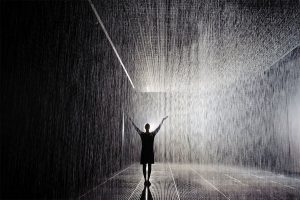
Another project I would like to share is Random International’s Rain Room, an immersive interactive environment, with perpetually falling rain, that ceases when a human body is in proximity. I love the simplicity of the interaction- basic sensors are used to create a truly awe-inspiring experience. The environment is an amalgam of natural and artificial, chaos and stillness, art and science.