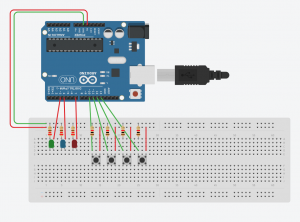
The goal was to set a combination that lights the green light and closes the red one.
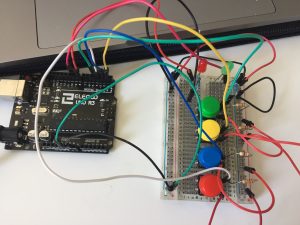
I used 2 buttons (a red one and a blue one), two led lights (green and red) and 4 resistors (2 ok 220Ohm and 2 of 10KOhm).
The combination is red>red>blue>red>red.
Simon’s locker- Carla Molins
- Goal of the project and/or desired interaction
The goal of the project was to create a locker that opened (green light) when the right color code was pressed ( 4 different colours). The light must be red while the code remains wrong.
- Quick description of assembly and list of core components
1x Arduino
1 x medium breadboard.
1x green LED
1 x red LED
4 x buttons
2 x resistors (220 ohms) – resistors
4 x resistors ( 10K ohms) – buttons
- How it works
My proposal includes a counter that allows to keep tracking of the correct sequence thanks to validating certain if statements. At the end, green LED lights up, and after blinking and a short delay, red light turns ON again, and it’s locked again reseting the counter to start again.
- Any problems you encountered and/or solved
I had problems to find the correct sequence that allowed to keep the good sequence. My counter kept reseting until I debugged the code.
Images of your circuit
.
Arduino Code
https://github.com/Lywa/carla_molins_Pcomp/tree/master/locker_v2
Joyce’s Lock(week 4)
Goal:
The goal of this project is to build a combination lock that uses 4 buttons and LEDs that indicates lock status.
Components:
red led x1
green led x1
blue led x1
button x4
resistor(200Ω) x4
resistor(10kΩ) x4
arduino board & breadboard
How it works
Users need to input a combination of 4 numbers to open the lock. The blue button is a reset light which will light up 5 seconds after the right code is input (The lock is locked again, the input is reset ) or the wrong four numbers are input (meaning please try again, the input is reset). The red light means a wrong code is pushed and the green light means the code is correct.

Code: https://github.com/joycemolly/pcomp–lock-combination/blob/master/homeworkLock.ino
Week 4 Assignment
Build a combination lock.
Design a program that turns an LED when a sequence of buttons is pressed.
- You should use 2-4 buttons.
- Your sequence should be at least 4 button presses.
- Use one LED to indicate locked and one LED to indicate unlocked.
Document your combination lock on the blog according to guidelines.
Week 4: Controlling Your World
Links to code not in Arduino examples:
Boolean_Example2
BlinkWithoutDelay
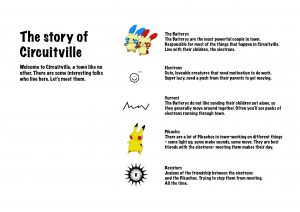
Week 3: The story of Circuitville
The story of Circuitville
Team members:
Aakanksha Aggarwal, Elizabeth Ho, Joyce Zheng
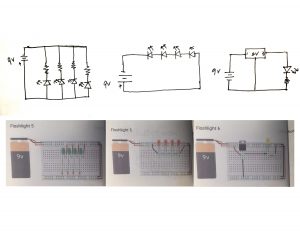
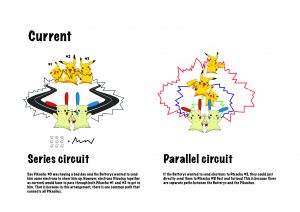
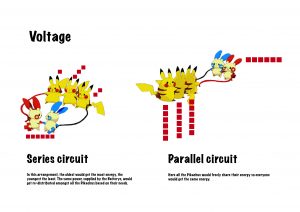
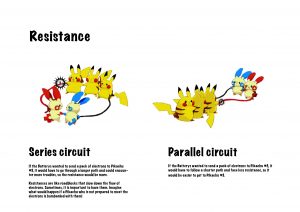
We wanted to explain the differences between a series and parallel circuit (in terms of the Current flow, Voltage distribution, and resistance) in a fun, and engaging way. We thought that making a narrative, and introducing characters would be an effective way to introduce the differences to complete beginners.
One of the major takeaways for us was that we learned so much about this concept while trying to making a teaching aid. Also, it compelled us to think about the core ideas, the logic behind the working of circuits instead of the numerical or symbolic representations.

A Guide to Resistors (Week 3)
Booklet: http://e.issuu.com/embed.html#2773574/58386795
Team:
Wen-Chi
Yujie
Carla
Dario
Alyssa
Yuemei
We chose to take a closer look at resistors because they’re essential to almost every circuit and involve a bit of calculation to understand and use properly. If we can succeed in fostering a better understanding of resistors, we can make circuit-friendly calculations and discernments quicker and better.
Challenges: We didn’t hit much resistance…sometimes it was tricky to balance the “right” amount of information to include.
Wins: This booklet seems pretty handy for a novice!
A tricycle modified by Canadian artist Nicholas Hanna mimics the Chinese custom of writing temporary messages on the road with water. A computer strapped to the handlebars of the Water Calligraphy Device allows the rider to type the Chinese characters they wish to spell out. These characters are transmitted electronically to a set of valves, which release water droplets in programmed patterns as the trike moves forward.The Water Calligraphy Device (水!法器) is inspired by the Chinese custom of writing calligraphy in public spaces with a water brush as a contemplative and poetic act. Calligraphers writing passages of poetry, surrounded by a group of onlookers, are a lovely presence in Beijing parks.
This is another work from Hanna that I like.
Week 2-Xu

Transistors – week 3
Group Member: Alya, Liliana, Min, Xiaoyu, Ron


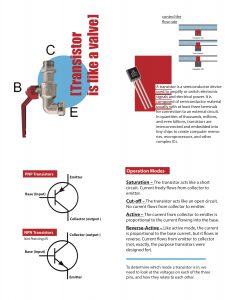
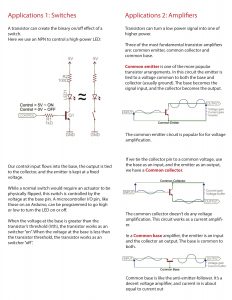
We choose transistors as our topic because transistors are fundamental in every modern circuit and can be used as either switches or amplifiers. But the principles and operations of transistors are too complicated to understand for people without engineering background. We have learned what is behind a transistor and how different transistors function. We found the metaphor that transistor can be described as the “valve.” What we are trying to do through the zine is to deliver the concept and functions in a more comprehensible way. We hope the layout is readable for screens and printed version.