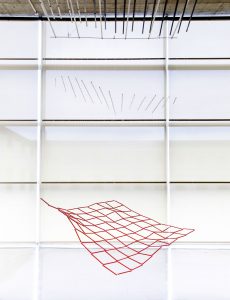
“Nemore” is a garden, consiting of 36 bendable graphite poles. “Nemore” senses the visitor. Each pole has a behavior and reacts to it’s neighbours only: and to the visitor, of course – the visitor acts an “alien neighbour”. We are interested in the question: Does a system arise from the poles behaviour, that we (the observers and the visitor) perceive as angst, curiosity, nervousness, etc.? Each pole has a distinct sound, that builds up a chord, fluctuating in resonance with the movement of the poles.
Max Kickinger describes the setup : “The poles are driven by two servo motors – one rotates the pole, the other one pulls up a coil with a fishing line attached, bending the pole. The garden is controlled by six arduino mega, a computer runs vvvv for the server application and pd for the sound. Sound works as simple additive synthesis made out of 36 sine oscillators. No sound is played, when the garden is in the “center-position” – only the irritation of the poles generates a modulation of pitch and amplitude : the wider the bending of the pole – the louder the according oscillator will sound. Pitch works in either way – up and down.
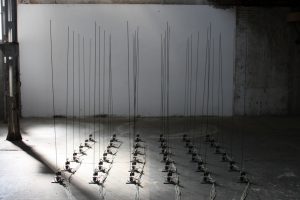
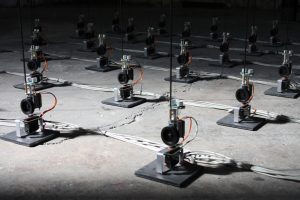
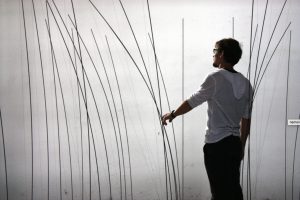

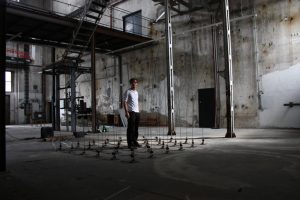 This art piece contains physical computing mechanism using movement sensor (ultrasonic? thermal detector?) to make servo motors rotate and bend the poles. In addition, each pole has a oscillator generating sounds according to the poles are bending. I am interested in sound and how its resonance affects to the space according to human interaction. Also I have an idea that “awakening our hearing sensor,” which is creating a new communication tool using variety of pitches and rhythms instead of language we are too accustomed to as much as we can easily hide or deceive our authentic feelings. I assume this “Nemore” project can be a brilliant technical precedence for my future project.
Created by “Fishing for Compliments” : Jan Bernstein, Max Kickinger, Woeishi Lean, Sebastian Neitsch