Joy Slippers

I stumbled upon this project from Hannah Perner-Wilson, called Joy Slippers.

They originally caught my eye on Instructables because I liked the aesthetic and there’s something intriguing about seeing old style coiled phone cables coming out of slippers.  I originally thought they were attached together, which seemed to have exciting implications, but they’re not as it turns out.  They have pressure sensors in them that send data back through the phone cables.

I also enjoyed looking at her x-IMU gloves.  Although, we’ve all seen the gloves loaded with sensors thing, i thought these ones looked a bit different.  I like the well controlled wires that are visible through the top.  It’s a good example of having an exposed guts look, while also looking very intentional.  For me, they also invoke connections to the central nervous system, which seems very appropriate.
ASSIGNMENT 1 // ARABIIA BY AYAH BDEIR

arabiia from ayah bdeir on Vimeo.

arabiiaStrip500pix

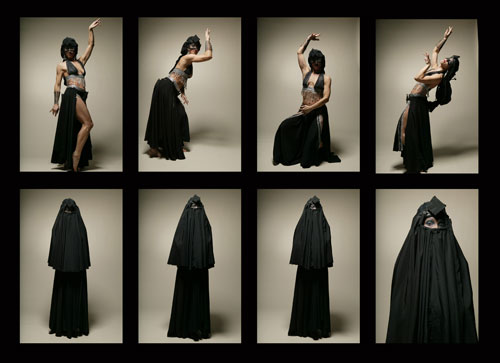
Designer/ engineer Ayah Bdeir decided to show the dual image of Arab women in the Us media in one of her projects at MIT. The combination of the strong concept of this project with the design choices makes it so powerful. The finishing appears to be perfect and does not compromise either of the messages that Bdeir was trying to communicate. I am curious to know more about the choice of fabric and the way the mechanism is handled because the transition looks smooth. 

Inspiring Projects – Xinhe

1. MaKey MaKey

http://www.makeymakey.com/

2. Kinematics – System for 3D printing complex, foldable forms

http://www.creativeapplications.net/openframeworks/kinematics-system-for-3d-printing-complex-foldable-forms/

I am always very into the concept of self-customization, or, let people make their own stuff. I strongly believe that as a designer, our mission today is not only to design a product, but also to design a service. We create tools or platforms for people to design their own products.

MaKey MaKey is a quite old project that many people may already know it. The interesting fact about it is that, it is an open-ended project. It encourages people to turn almost anything around their life into a digital input. And the infinite possibility generates a different way for people to think about the relationship between digital and physical world.

The Kinematics is a 3D printing system, which means is also let people put their own creativity and need into it. The 3D form itself is beautiful, and to think of different ways to use it is even more excited.

Twitter Controlled Couture

I love the elegance of the work displayed here. These designers (Cute Circuit) come from the point of view of “let’s make something gorgeous” and then they figure out what tech will serve their piece, rather than deciding the tech comes first and working the piece around it. The twitter skirt is fantastic because it is beautiful and functional. The purse is gorgeous. The shirt is simple and elegant. I just think it’s so important to make tech decisions based on what type of piece you want to design.

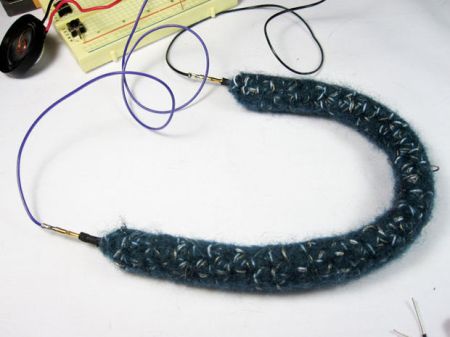
This felted crochet sensor project by Instructables user, push_reset, serves as an inspiration for my upcoming Computational Crafting class at Parsons The New School for Design. I appreciate many aspects of this project, from the aesthetic to the functionality. Aesthetically speaking, this project intrigues me. I find felt appealing both visually and as a malleable material that I like to incorporate into my work. Sensors often have a very singular look – metallic and cold – however, push_reset’s sensor is delightfully subversive in that it is inviting, touchable, and soft. As for the functionality, I read her documentation (which is excellent) and I appreciate that this flex sensor is seemingly rather reliable. I’ve had a slew of unfortunate experience with rubber and metal flex sensors, and found them underwhelming in their reliability. push_reset had similar experiences and then went on to make this sensor in order to have the aesthetic and reliability that she desired. Cheers!

by Joselyn McDonald

felt_resistant

http://vimeo.com/12997478

http://vimeo.com/12997478http://vimeo.com/12997478

Link

2_gaze_activated_dresses_ying_gao-thumb-525xauto-56112

2_gaze_activated_dresses_ying_gao_3b-thumb-468x702-56116


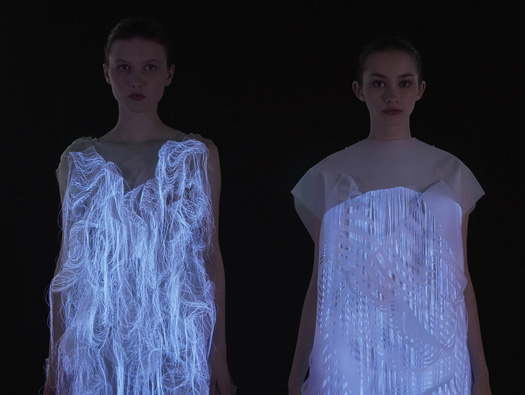
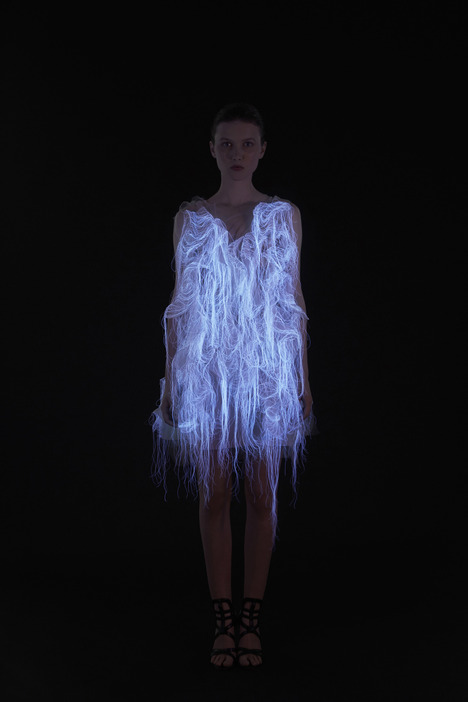
This project is called (NO)WHERE (NOW)HERE by Ying Gao. The series comprising two (2) dresses, made of photoluminescent thread and imbedded eye tracking technology, is activated by spectators’ gaze.

“A photograph is said to be ‘spoiled’ by blinking eyes – here however, the concept of presence and of disappearance are questioned, as the experience of chiaroscuro (clarity/obscurity) is achieved through an unfixed gaze.” says Gao.

Week 1 – Self-folding Paper

5344592286_e24287d726_z 5344592738_26c49c9a8c_z

Input-output paper is a piece by Jie Qi.  The piece uses two pieces of origami paper.  The red paper acts as the controller and takes input from the user, and the white paper replicates and outputs the same movement.  The simplicity of the design, subtle movements, and paper engineering are all intriguing components of this piece.  It’s a simple prototype that can be expanded into different arenas of design and holds qualities that can be used in projects with both functional and artistic characteristics.  For example, the white paper can flip itself over and wobble when it is flipped over due to the folding technique, blintz folding.  The number of materials used in this piece are small, and many of the materials are easier to access and use, compared to larger-scale physical computing projects with similar interactions.  The materials used in this piece are: paper, microcontroller, shape memory alloy, copper tape, wires, and solder.

Nicole Yi Messier

Inspiration (Week1)

Oncle Sam Popcorn Machine

Oncle Sam

I am always interested in small objects and the little details attached. This popcorn making machine focus on one corn kernel each time. Heat up the kernel with the right amount of the oil, wait for a few time, season the popcorn with a little bit of salt. In this case, you will avoid the alarming amount of fat and calories unlike the cinema popcorn. To me, it is an observation of how human activities change an object into another form, the processing of designing, objet d’art.

Week 1 post – inspirational project

Noa Raviv’s Impossible Clothes

This project is a fashion line that uses 3D-printing as a means of producing some very interesting pieces. Noa draws inspiration directly from Greek and Roman sculptures and creates the graph patterns using a 3D rendering program from what she terms “impossible commands,” which ultimately “break” the program (i.e. glitch art). In spite of the garments’ general “3D photocopied” nature, Noa gives a nod to couture by combining traditional sewing (e.g. draping, hand-stitching) techniques with the mass-producing 3D printing. The resulting garments are both fluid and structured and visually stunning.