Category Archives: Assignments

Week 2 Assignment

“Oh, grandmother, what a horribly big mouth you have!”

“All the better to eat you with”

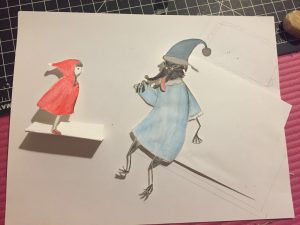
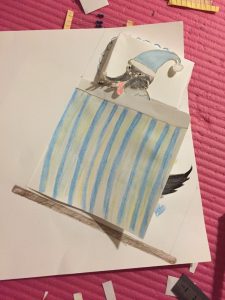
This is an impressive sentence for me. It is from the story The Little Riding Hood.  So I chose to illustrate this scene in which the wolf and the little riding hood were having a talk about grandmother’s weird appearance and then the wolf threw back the quilt and revealed his real identity with its eyes blazing with greed.

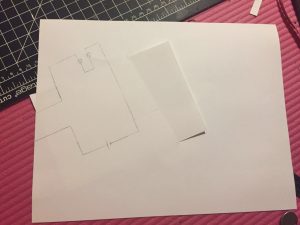
In this project, when the quilt covers the body of the wolf, nothing happens. When players remove the quilt, the eyes of the wolf begin to give out light.

Process


1. Prepared the characters.


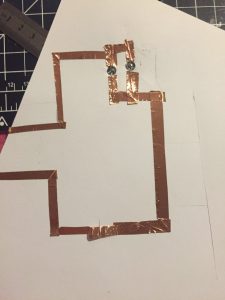
2. Designed and made the circuit.


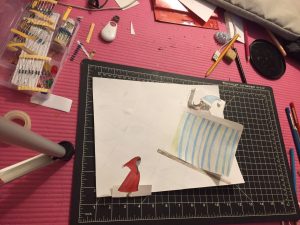
3. Assembled all parts.

Demo:


Assignment 2: Tong Zhang

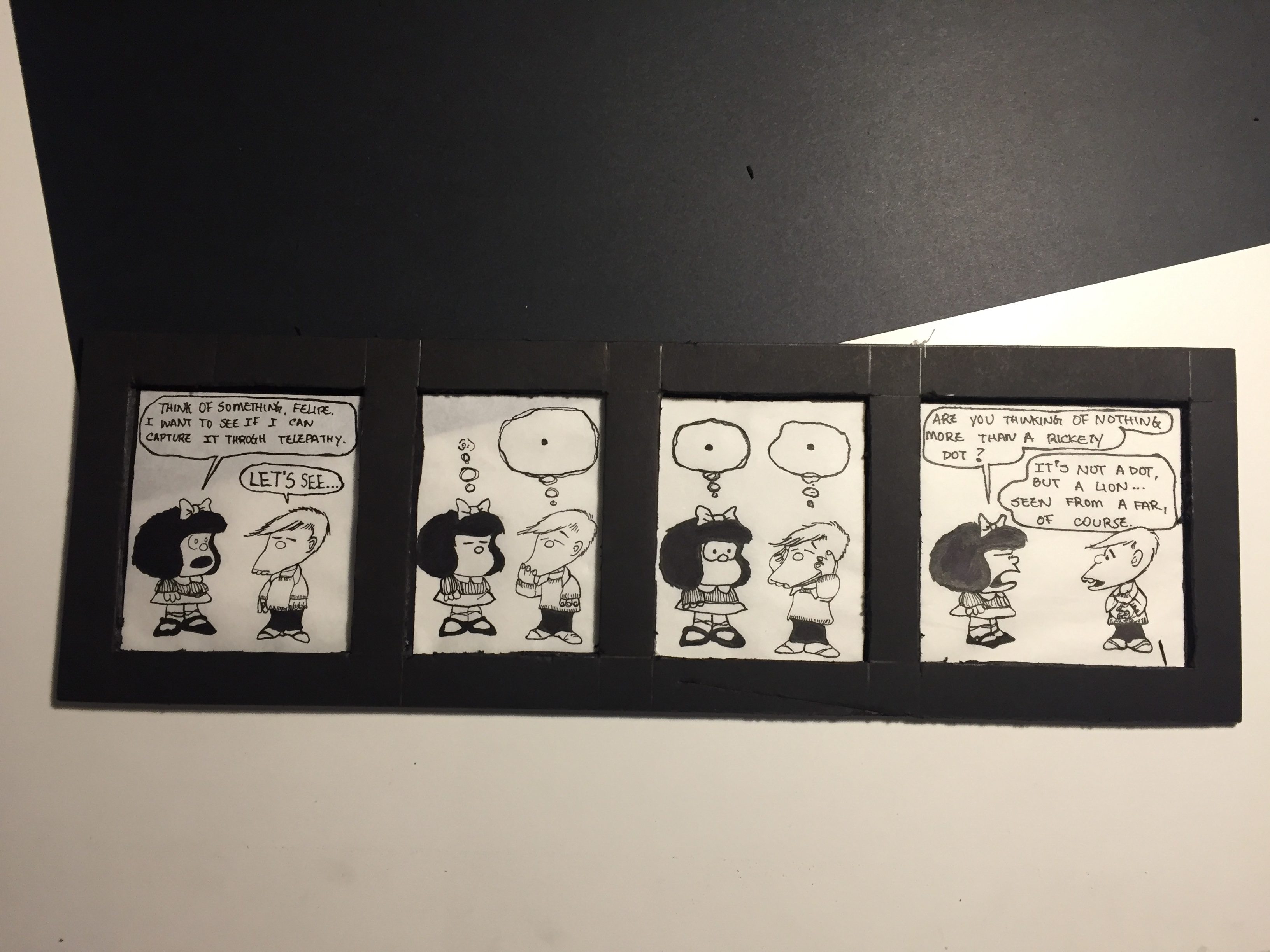
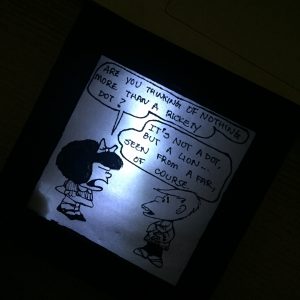
I chose a quote from one of my favorite comic strips, Mafalda:

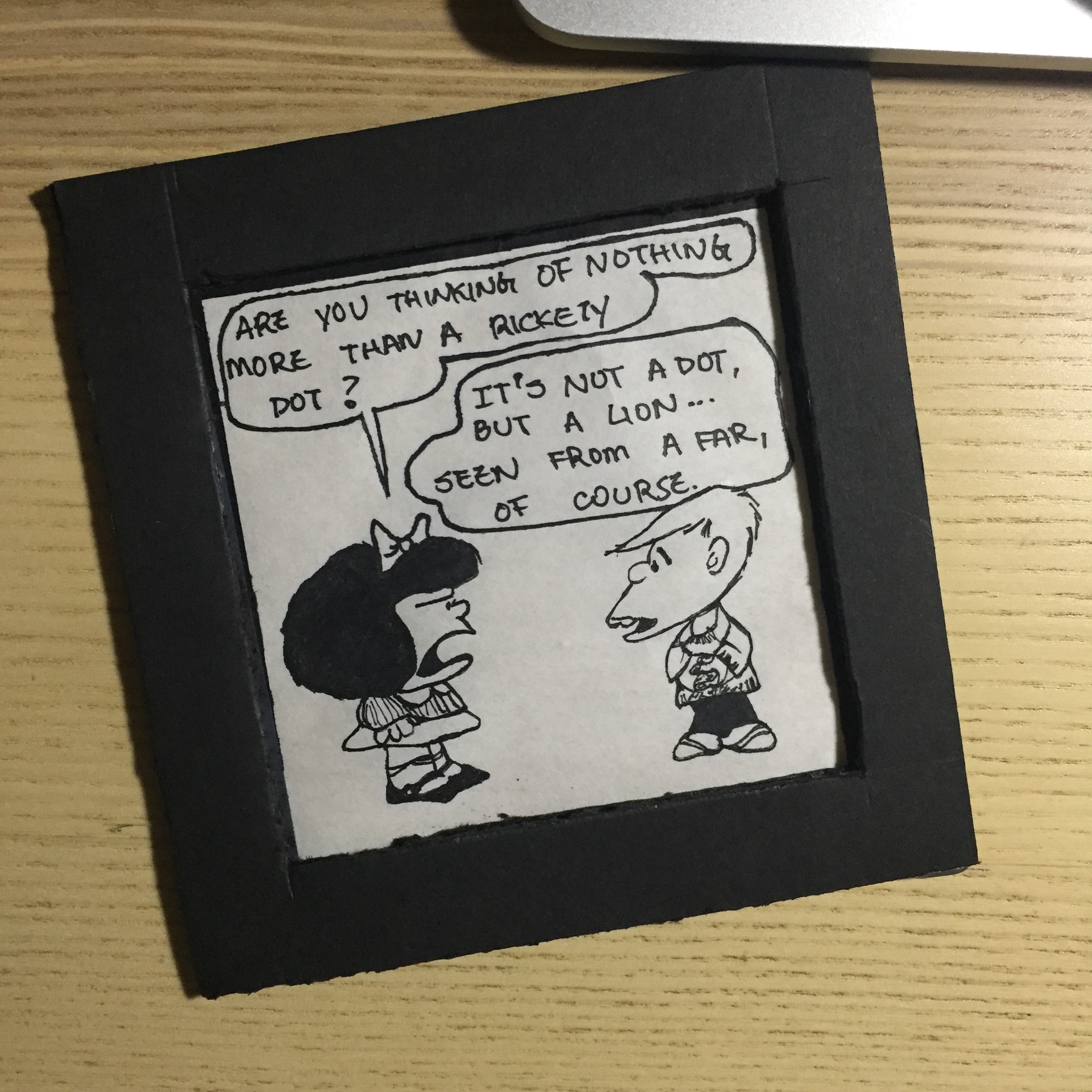
I chose my favorite scene from the strip, which was the last scene. I wanted the audience to have an interactive experience with the scene, so that when they pressed onto the comic, it would light up and can be read in the dark as well.

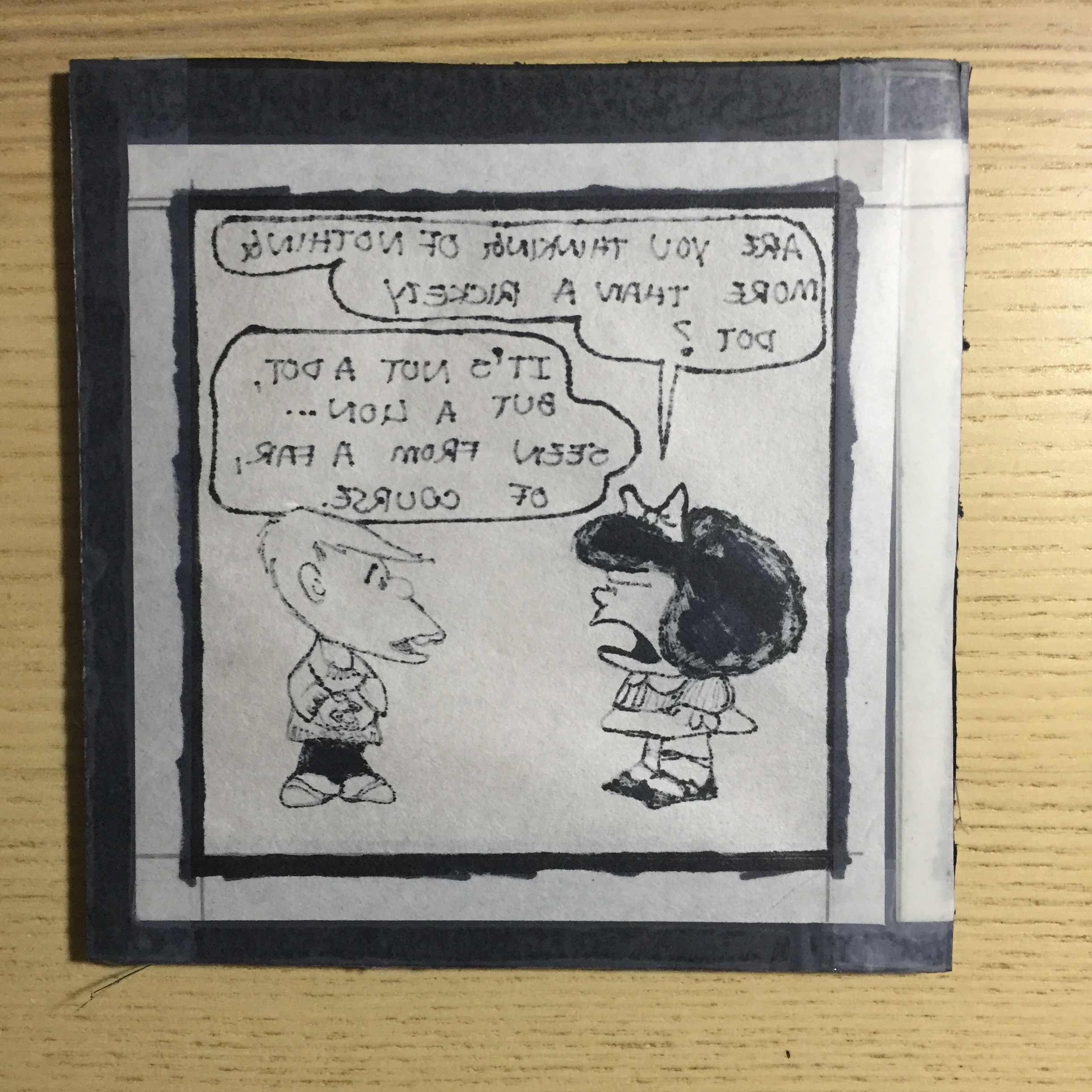
I began the process by tracing the drawing onto rice paper (I wanted a material that was relatively translucent but not enough to see through). Then I cut the foam board into a small box.

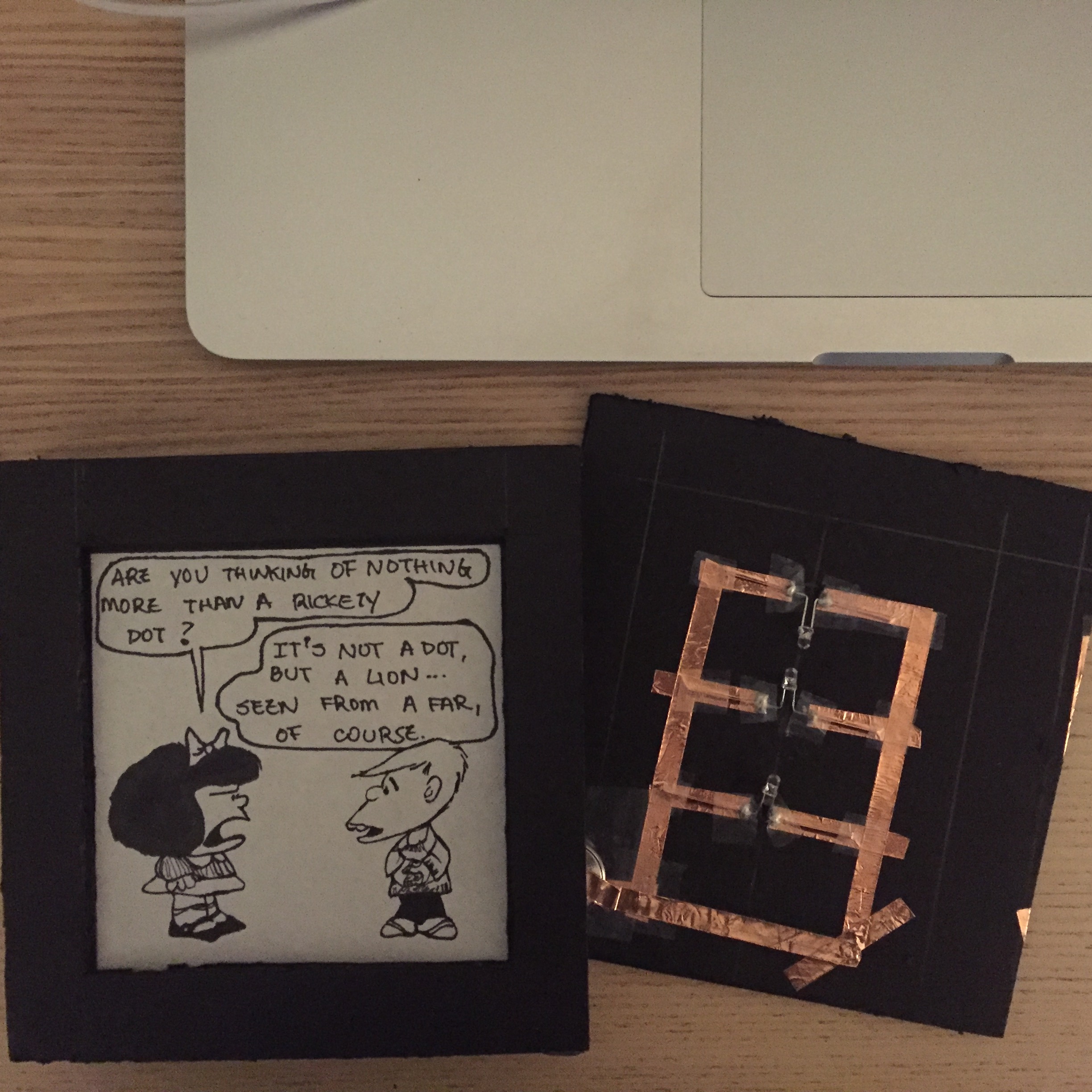
Then I made a parallel circuit with copper tape underneath to light up 3 LEDs.

One of the difficulties I encountered was getting the pressure to work as the foam was too hard to press onto. To solve this I had to use a combination of cotton pads and cardboards to fix underneath the pressure point. Once it worked, I sealed the box.

Documentation Video:

Week 2 Assignment

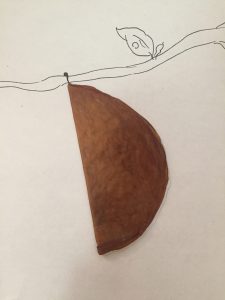
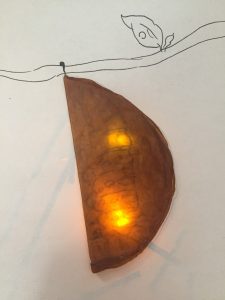
I chose the children’s book The Very Hungry Caterpillar and the scene I chose to illustrate was when the caterpillar was inside of the cocoon resting. Since we can’t see the caterpillar inside the cocoon, I wanted to illuminate that the caterpillar was indeed inside the cocoon undergoing transformation. So on top of a drawing of a caterpillar I taped a piece of scoby on top to hide the caterpillar and act as a cocoon. When the lights shine, you can vaguely see the caterpillar resting inside of the cocoon.

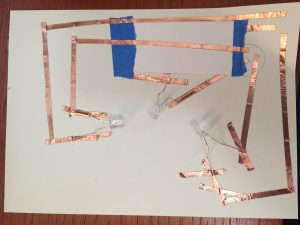
My first attempt, I used a thicker piece of paper and the light was able to shine through, but it was so thick that the lights weren’t bright enough to illuminate the drawing through the scoby. Here is the circuit that I built:

I ended up redoing the drawing on a regular piece of printing paper and since it was thinner than the other paper I used, the light was able to illuminate the caterpillar.

It is hard to see from the photo, but I think its clearer when you see it physically.

Assignment_02

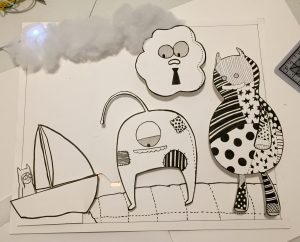
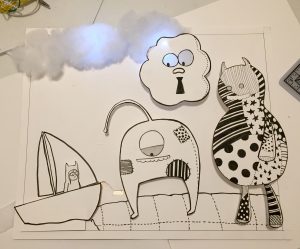
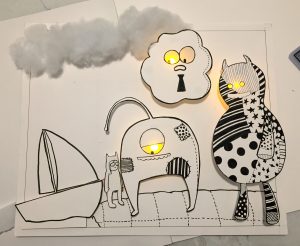
For this assignment, I took a passage from my favorite book Where the Wild Things Are? by Maurice Sendak. Instead of taking imagery straight from the book’s illustrations, I decided to put my own spin on the characters.

In the book, Max, who is the main character, gets sent to his room for misbehaving. While in his room, it turned into a jungle. He gets into a boat and travels for what feels like years to an island where the wild things lived. The passage I chose goes:

“And when he came to the place where the wild things are

they roared their terrible roars and gnashed their terrible teeth

and rolled their terrible eyes and showed their terrible claws

till Max said ‘BE STILL!’ and tamed them with the magic trick

of staring into all their yellow without blinking once

and they were frightened and called him the most wild thing of all”

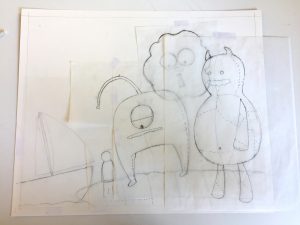
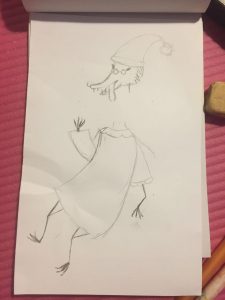
I started my making process with a sketch of the layout of my composition. I like to work with layers of tracing paper, so i can easily move different elements without having to erase or damaging the paper too much.
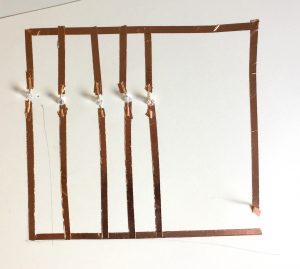
Next, I made a prototype of my circuit. Because the monsters have a total of five yellow eyes combined, I wanted to make sure I can light all five LEDs with one 3v battery. It worked.
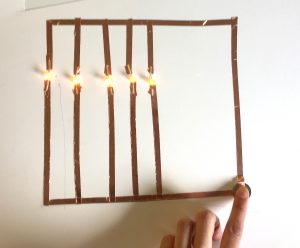
The circuit is split between two sheets of paper, the top being the negative and bottom the positive. I first mapped the circuits on the back of the top sheet of paper, then traced it to the bottom sheet of paper. Once I finished mapping the circuit, I started laying down the copper tape.
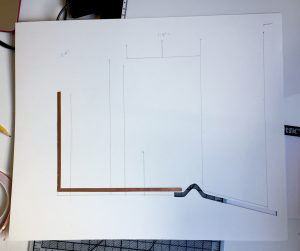
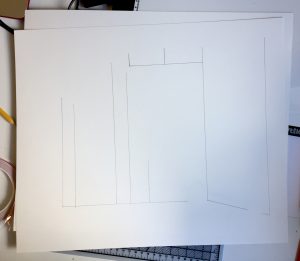
To keep the circuit from crossing with one another, and shorting them, I had to put a “rise” on the sheet.
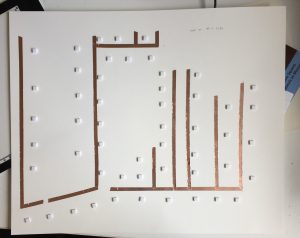
After I finished laying down the circuit, I had to put in the LEDs. This was the most difficult process. (I was so wrapped up in taping the LEDs down, I forgot to document this process.) This was especially difficult because I had to tape one leg of the LED to the top page, then do the same to the bottom page. I broke two LED legs while doing this, and I found that some of the LEDs weren’t getting any power. I also discovered that the connection needed to be soldered, otherwise they weren’t getting enough contact on the circuit to light up.

Once the LEDs were in place and working as the should, I placed all the characters in place.
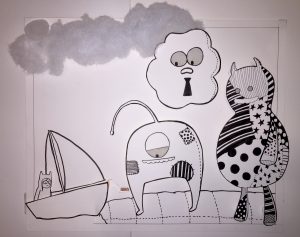
    

Here is a video of the interaction:
 

Week 2: Assignment

Illustration Project

Pick sentence or passage from a story that you like (children’s storybooks work VERY well). Illustrate one scene from that book and integrate a circuit into it using the materials we discussed in class.

  1. You must use at least 2 LEDs
  2. Focus on the construction and aesthetics.
  3. Post documentation to the blog and bring your final product into class.

Week #1 Assignment


I was really impressed wit the possibility of projecting something in any clothing piece, after a research, i also found this two references that are really stunning and in my point of view a new innovation into the e-textile world. For me the most amazing is the different application you can put into this technology specially in interaction design that affects people behavior in their day to day basis.

EINK DRESS

Text and video by Eink at DNP booth in Retail Tech 2017.

Electronic Dress, color-changing ink technology in E Ink Prism, each tile can not only change its own hue, but also be programmed to create different patterns in conjunction with other modules.


MEMBRANE

Text and video by bymelt.com

Membrane – a tactile screen is a human-size interactive touchscreen made of fabric. It’s a lifelike technology. You can touch it and feel it reacting. The organic structure and feel of the fabric provides immersive and tactile experience. The door-like size lets us have an interactive dialogue with the viewer. The fabric reacts to your touch. Every time it generates distinctive animations. It feels the pressure of your touch. Everything impacts both visuals and sound. Redefining the touch interaction mechanics it resembles more of a living organism than a piece of hidden technology.

Week 1 Assignment _ Chang Liu


IMG_4184

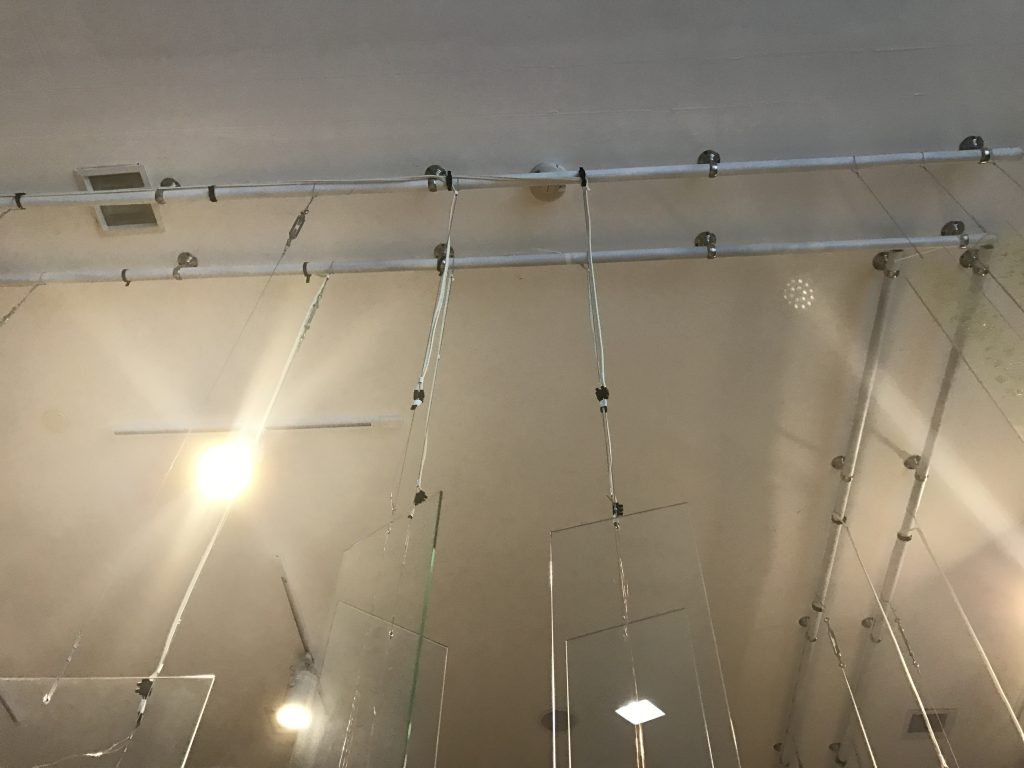
Listening to Transparency: Denys Vinzant: D’Ore et d’Espace | 2000-2012 | Sound Installation

I saw this modular installation D’Ore et d’Espace(meaning of “in this moment”) in the Shanghai Minsheng Art museum this summer. It consists in more than two hundred scores written on the glass, and each exhibition is an occasion of a new creation, which proposes some “imaginative architectures” depending on the space that it occupies.

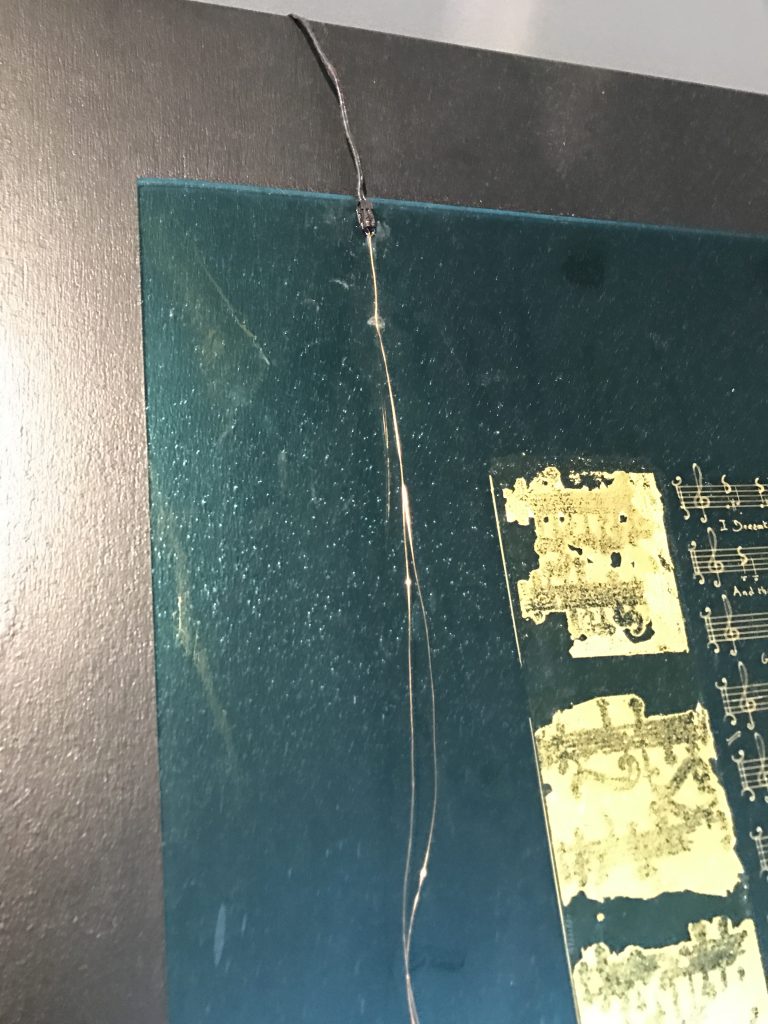
It is constituted by an ensemble of glass plates while the most of them are sonic. Crystalline tones, “pearl notes”, sound streaming, the installation of Vinzant presents an ensemble of scores written on the glass or stained-glass plates with golden ink. By the intermediary of transducers fixed on the plates, the sound propagates on the surface of the vibrating glass, playing like that the role of a membrane of loudspeakers.

Handwritten, with a play of transparency, where audio and visual communicate together, these scores represent an integral digest of unheard music.

Week 1: Inspirational project

Lilytronica – Afroditi Psarra – 2013

The most fascinating aspect of this project for me is the interface that was created for this project. As textiles alone, these controllers are visually compelling to me. It’s interesting because it could look like anything, it might as well have been just a jumble of sensors on the fabric and it would still serve the same functionality, but Afroditi decided to make things as though they are recognizable instruments such as the piano. I’m less interested in the sound aspect of the project but I really can appreciate that these controllers can be folded up neatly and take out without being too cumbersome.

-Dylan

Week 1 Assignment

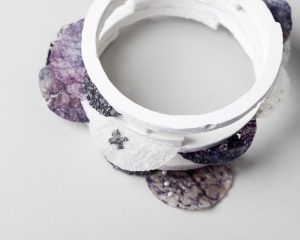
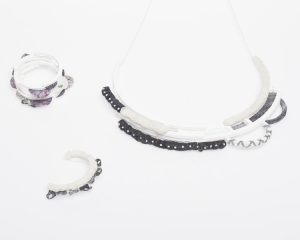
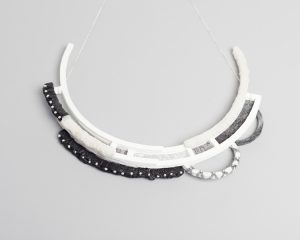
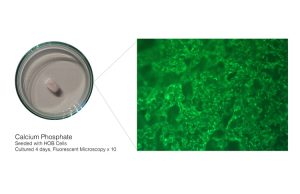
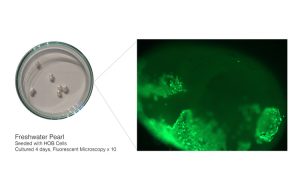
The project in the week 1 slideshow that I found most interesting was mycoTEX because it was about creating garments out of the living material mycelium. I think Aniela’s idea to rethink the future of materials is important in finding materials that are sustainable. I found this project by Amy Congdon called “BIOLOGICAL ATELIER :  AW 2014 ‘HAUTE BACON’ COLLECTION”. Although this project isn’t made using the same material mycelium as in Aniela’s project, this project utilizes and envisions the future where living materials and biotechnological processes can be combined to create fashion. Amy’s piece uses the process of decellularization on bacon. This process removes all of the cells within the outer structure leaving the scaffold of the original material. With this she incorporates bone powder and pearls into the scaffold as well as traditional techniques such as dyeing, tanning, and weaving to create this jewelry. Similar to that of Aniela’s project in that Amy is trying to rethink and envision what the future of materials will be like.