Category Archives: Uncategorized

Week 3, In Class Assignment: Nipple Gnome

w: Jed Segovia & Eliza Bruce

Description: The swatch contains white conductive yarn that contains positive and ground leads embedded into the swatch.

Materials: Regular yarn and conductive yarn.

Techniques: The swatch was made by knitting.

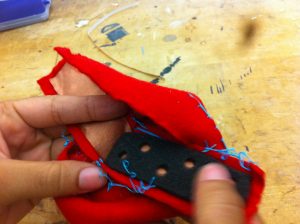
What it does: This is a button/pressure sensor that reacts to being squeezed. The patch on the bottom is sewn with conductive thread which is connected to conductive snaps. The patch on the bottom is connected internally to a “flap” which is lined with conductive copper fabric and a sliver of conductive foam for detecting the squeezing.

2016-09-13-20-06-08 2016-09-13-19-53-30

Mysterious Swatch (Cat + Alonso)

Title:

The Monet of Fabric Swatches

Description:

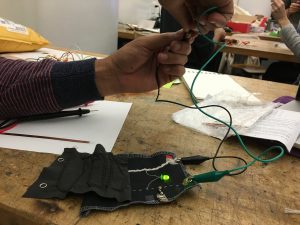
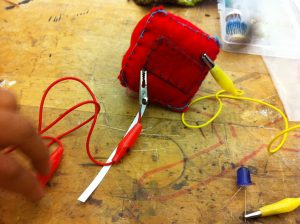
Through the use of a multimeter tool, we determined the conductive parts of the swatch. We used alligator clips to connect different parts of the circuit together with a battery and an LED.

There are two metal hooks connected to conductive thread. They create a simple circuit when you add power and a light to it.

Materials:

Conductive thread,  conductive fabric, conductive snaps.

Techniques:

The swatch was sewn.

Function:

Post Human Remote Control


img_2213

Week 3 In-class Assignment

You are a research team of material scientists, interaction designers, and craft historians. Your current project is examining interactive electronic swatches found at a historical site.

Using the tools and knowledge we have discussed so far, determine how the swatches work.

Document your findings in a blog post with the title Week 3 Sensor Research: (Title of your swatch(es)

Title. Give it a name
Description. What does this swatch do? How does it work? Please document any methodologies you use to determine its function (e.g. multimeter, LED tests, etc). If you would like to take it apart, please ask me first.
Materials. What materials are used?
Techniques. How was this swatch constructed?
Function. How is / was this used in everyday life? Where have you seen it before?

Assignment week 2 [Eliza]

img_1197 img_1204

img_1199

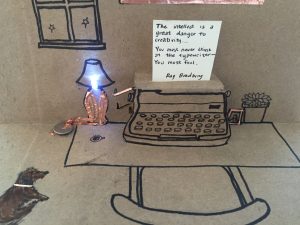
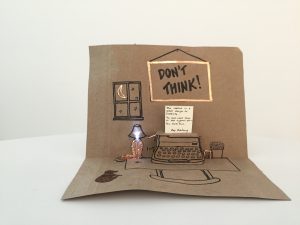
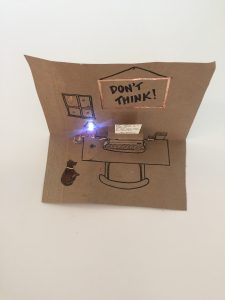
So this illustration is actually based off of a quote I read from Ray Bradbury about creativity that stuck with me because I overthink everything. I really wanted to practice my paper engineering here (clearly) so my circuit is maybe the secondary thing in this picture. But I styled the copper tape like a wire from the lamp that lit up the scene slightly. I was originally going to light up the sign above the desk, but I realized it would prevent me from writing the actual sign itself, having a battery and a bunch of copper tape in the middle of it (unless I wanted to use a bunch of batteries and hide those; sigh, maybe next time), so I stuck with the little lamp.

Week 2 homework _ Cat Schmitz

img_2193-1 img_2211

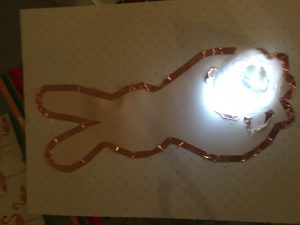
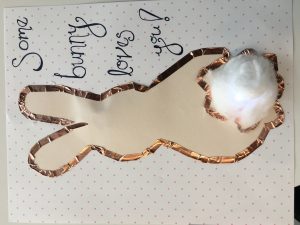
Above is the homework. I wanted to make an illustration of a bunny rabbit. This isn’t particularly from a book, but I’ve seen the little quote pop up everywhere. The second photo is the final, it’s hard to tell that the light is on. The battery is hidden underneath the head.


img_2185

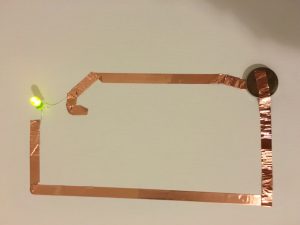
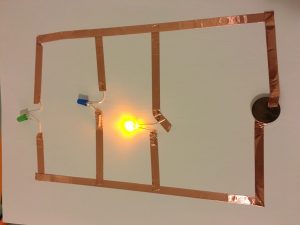
In class activity #1- worked well!


img_2187-1 img_2188-1

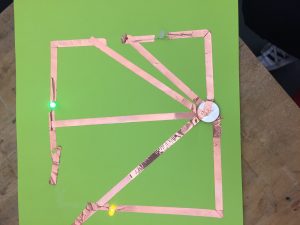
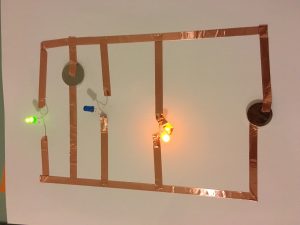
In class activity #2- did not work so well! I tried adding some extra batteries, but then I think I overheated my LEDs. Not sure what the issue is.


Jed Segovia – Illustration Project – The Little Red Hen

2016-09-12-21-12-23

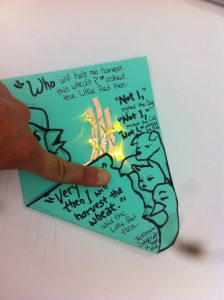
My chosen passage is from The Tale of the Little Red Hen.

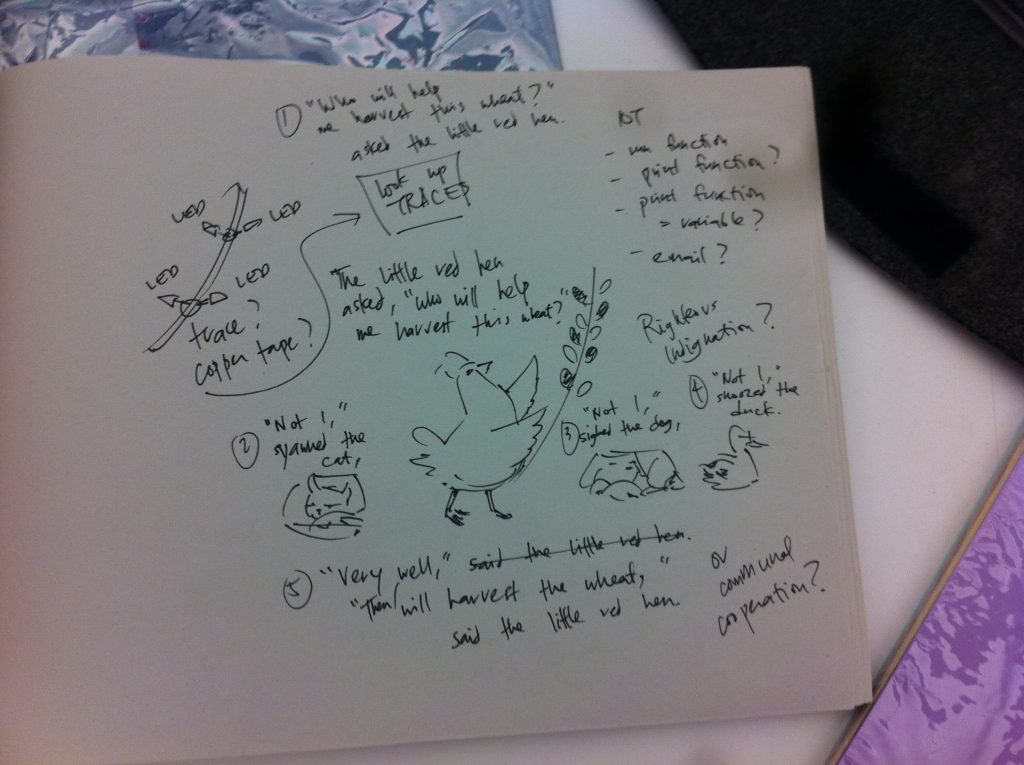
Here is my sketch of how I wanted it to look.
2016-09-12-19-10-39

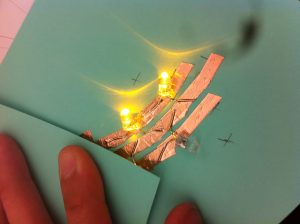
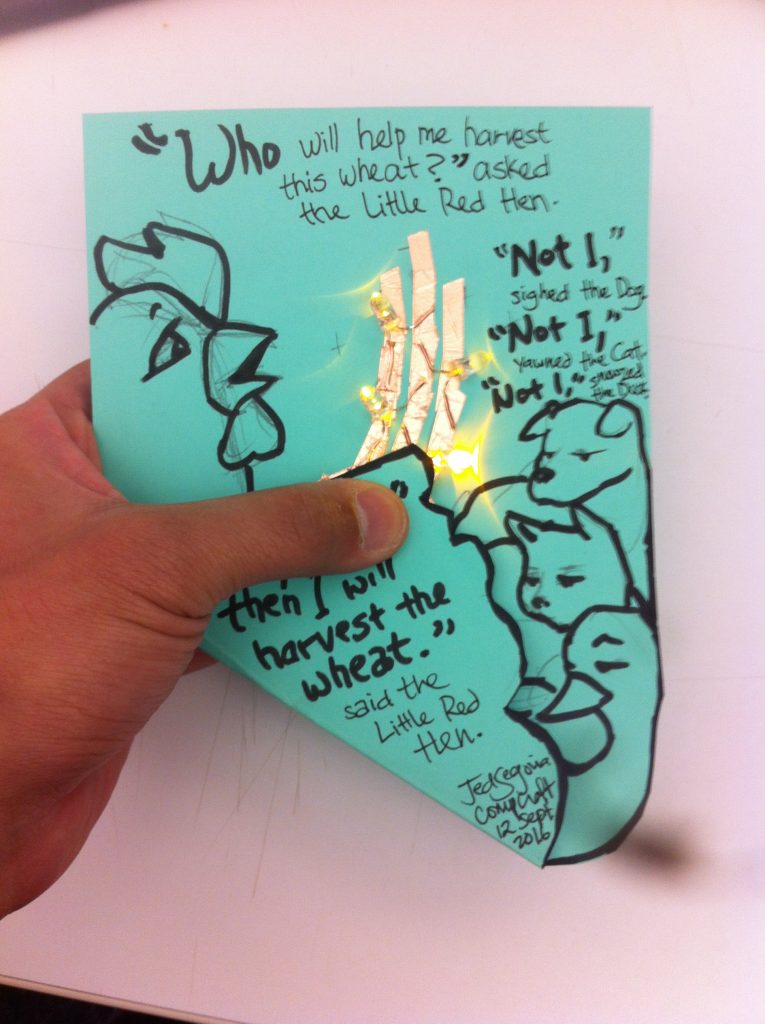
I wanted the wheat to be the central piece of the illustration. I wanted to use yellow LEDs as the wheat buds. So the hard part was crafting traces to give it a smooth, organic look for the wheat stalk. Once I had the circuit done, I would illustrate around it.

I decided to make a parallel circuit because I learned last class that series circuits don’t work with 3V batteries.

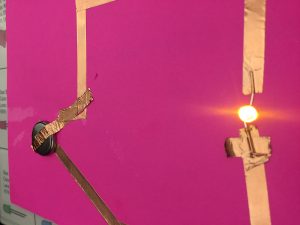
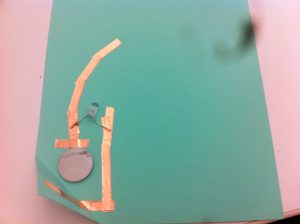
I first did testing of the Simple Circuit Diagram, using High-Low Tech’s tutorial as a reference. 
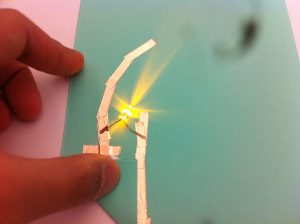
2016-09-12-14-43-58 2016-09-12-14-44-01

Once I got one LED lit up, I added a second LED. This time, I added a second trace.
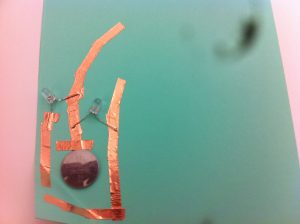
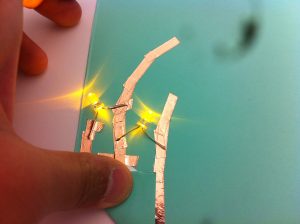
2016-09-12-14-52-05 2016-09-12-14-52-13

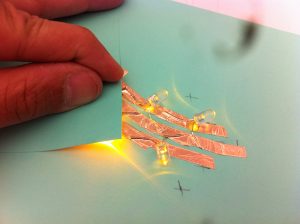
Once I got those in, I felt confident. Now I wanted to add a third LED. This time, I wanted to bend the LED nodes so it wouldn’t be awkwardly sticking out. I took out my long-nose pliers and tested it out, by bending the nodes.
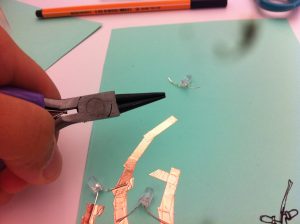
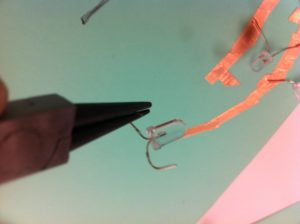
2016-09-12-14-57-18 2016-09-12-14-57-46

So you can see, I got it curved nicely. And once I got that working…
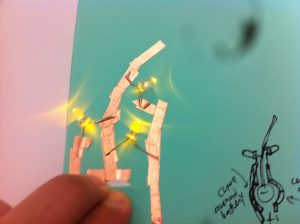
2016-09-12-15-00-33

Three LEDs!

So I sketched out a diagram to refine the next iteration, once I got the principles working.
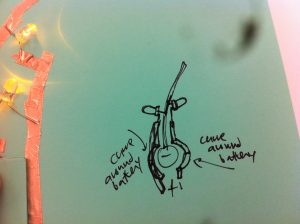
2016-09-12-15-00-36

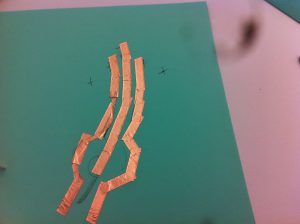
I couldn’t figure out how to hide the battery in the time I had. So I worked a diagram that at least aestheticized the circuit. So I went to sketching the illustration. First, I drew out the wheat stalk, that would serve as the circuit path. This would be the negative path. Then I followed by adding two positive paths. Once those were drawn in, I added copper tape.
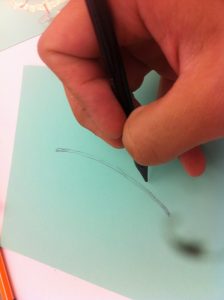
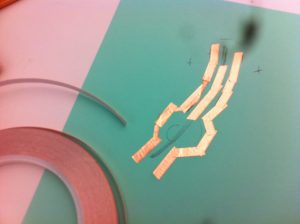
2016-09-12-15-09-42 2016-09-12-15-26-43 2016-09-12-15-28-31

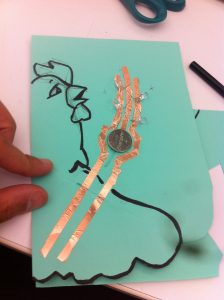
Then I hit a problem: how to activate the circuit? I first thought about making a pop-up component: I would put in a folding wing and integrate it into the illustration. The wing would be the chicken’s wing, with copper tape put into it. So I tested that.
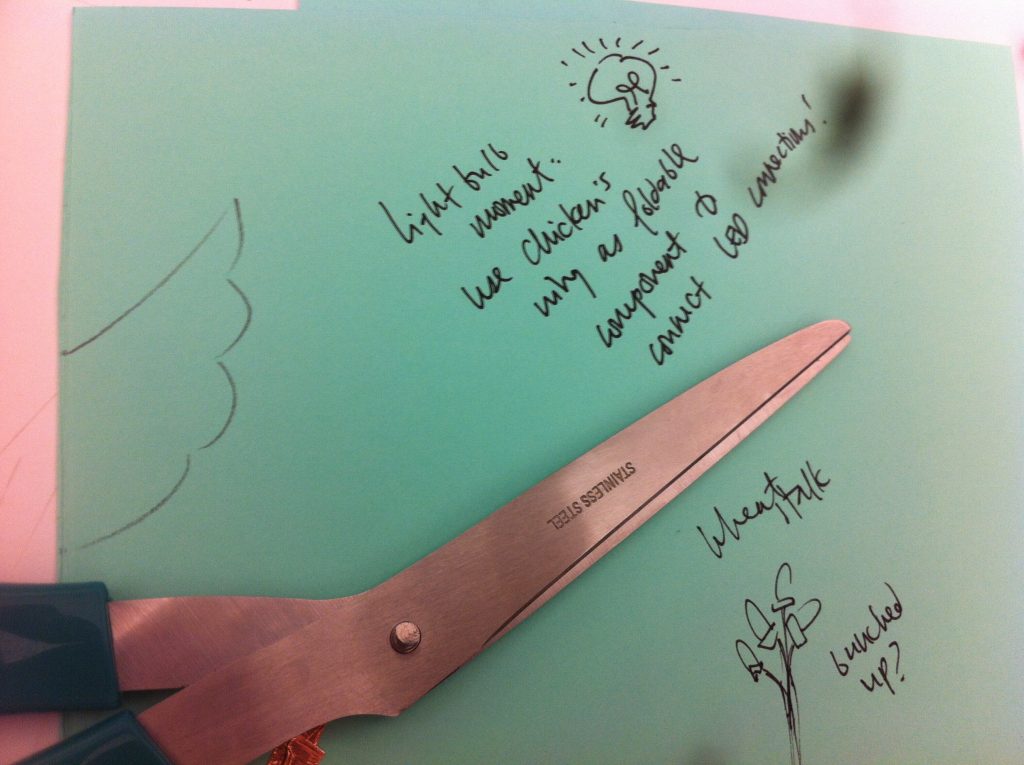
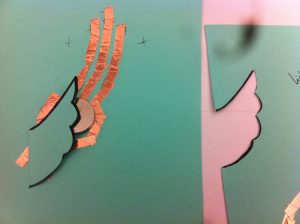
2016-09-12-19-47-56 2016-09-12-19-54-13

As you can see, I ran into problems right away. I didn’t measure the wing so it wasn’t large enough to cover both the circuit and allow for space to be taped into the paper.

I hit an impasse of forty minutes. Forty minutes of frustration and panic because I couldn’t get the circuit to work. Was it because the copper tape wasn’t connected enough? Were the LEDs loose? I had no idea. I got it to light up but not totally.
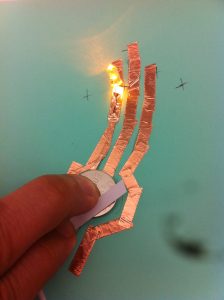
2016-09-12-20-04-34

Then I kept looking at my first circuit, which was working…

2016-09-12-15-00-33

So why not use that, and stylize the folding corner as a wing? That was born out of necessity than anything, but it was a great creative solution to me.
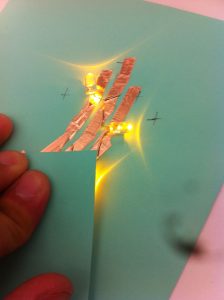
2016-09-12-20-35-45

So there!

2016-09-12-20-45-362016-09-12-20-43-18  2016-09-12-20-45-28

Now it was a matter of illustrating the scene, and integrating the circuit solution into it.
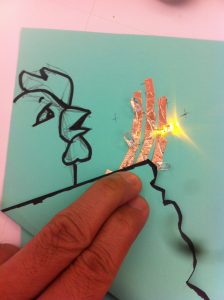
2016-09-12-20-58-052016-09-12-20-58-09 2016-09-12-21-12-072016-09-12-21-12-36   2016-09-12-21-12-23

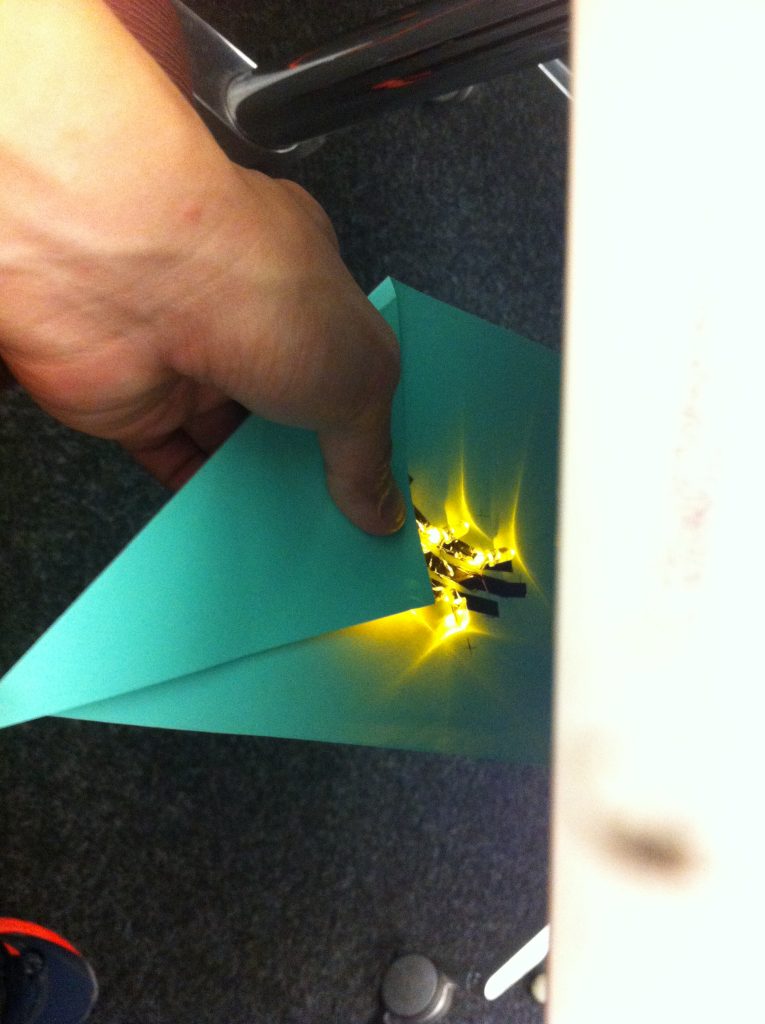
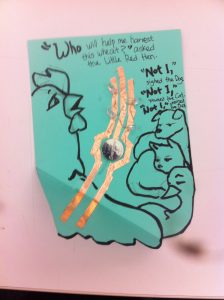
And there we have it! A scene from the Tale of the Little Red Hen, with light-up LED wheat buds. I’m really, really happy it works. It needs a lot of hard pressing to light up, but it lights up, and to me, looks GREAT.


[EDIT: Wait… I reviewed the homework and it said it wasn’t supposed to be “interactive.” Is… this interactive?]
 

Day 2 – Class Circuits – Jed Segovia

2016-09-06 21.33.232016-09-06 21.33.41


Circuit 1
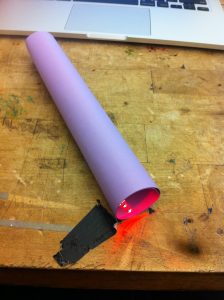
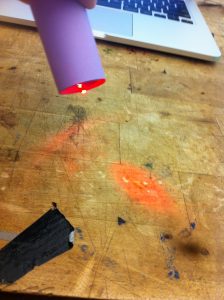
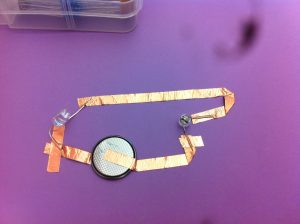
My first in-class circuit was a simple LED-3V battery combination. Using copper tape to fasten the ends of the LED to the negative and positive sides of the battery, I fashioned a rudimentary flashlight. I used a rolled-up tube of art paper, tape to hold the tube together, and the LED-battery combination, taped into the inner lining of the tube.

2016-09-06 21.26.28


Circuit 2

My second circuit was an attempt to make a series circuit with the 3V, copper tape, and 3 LEDs. I knew that to wire the series together, the positive end of the LED had to be attached to the negative end of another LED, and so on. It didn’t work, and it was only after speaking with the instructor after class that I learned from her that series circuits don’t work if made from 3V batteries. The more you know!

Assignment 1 – Jed Segovia

I’m really intrigued with the Input/Output self-folding paper. It looks like living origami. In fact, it’s the organic quality that attracts me to it. I’m intrigued by the concept of biomimicry, and this folding paper makes it look like a living flower. This project intrigues me because it makes me think of self-folding origami. I like the idea of folding paper into an origami shape, not by touching it, but by channeling a current into specific parts of the paper.

From http://thenewstack.io/self-folding-mini-origami-robots-are-the-nanosurgeons-of-tomorrow/

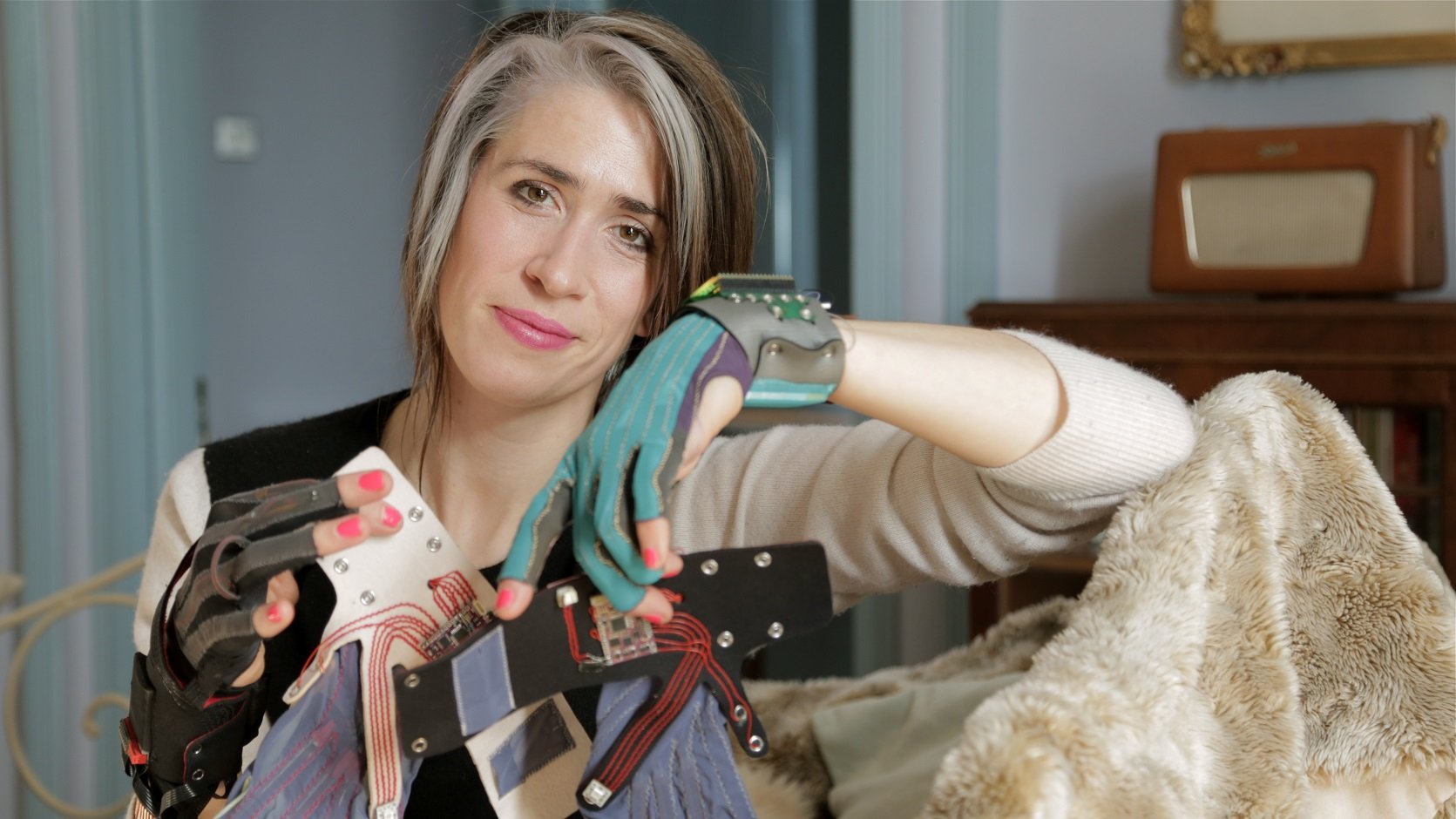
I also love the Mi.mu gloves. I looked at the Mi.mu website to see how the gloves were made. It’s a fascinating product of musicality, intuitiveness, technology, and craft. I love that Imogen Heap demonstrated it in the context of a performance/lecture/concert. It was a great demonstration of the technology (if it wasn’t the greatest faked performance ever, because it looks magical).

From https://www.virgin.com/music/all-you-need-is-glove-imogen-heap-and-the-kickstarter-dream

I also discovered the “Cognitive Dress” from an IBM ad I saw online. A collaboration between British design studio Marchesa and IBM Watson, the dress debuted May this year at the “Manus x Machina: Fashion in an Age of Technology” Costume Institute Gala at the Metropolitan Museum of Art in New York City. Worn by model Karolina Kurkov, the dress was designed with LEDs that would change colors based on the reactions of Twitter users following the Gala.

From http://www.cbsnews.com/news/marchesa-ibm-watson-to-debut-cognitive-dress-at-mondays-met-gala/

From http://adage.com/article/digital/ibm-marchesa-debut-cognitive-dress-met-gala/303827

Lara’s eTextiles

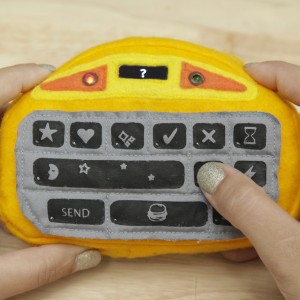
Lara Grant made an interesting series of eTextile projects with accompanying instructables instructions for it, which I think is awesome and very helpful for beginners like ,e. The project that stood out to me most was a messaging controller made out of fabric and a microcontroller. I thought it was so amazing because the form hides conceals the tech so well and integrates a completely polished and fun aesthetic. I don’t have much experience with electronics, so I’m easily amazing by electronics projects that integrate fabric and non-traditional mediums.
ETextiles_029-300x300